Understanding Solar Panel Costs: A Practical Pricing Guide
By PVFirms, Published on 2026-08-15 • 8 min read

Solar energy has never been more mainstream — but the price of solar panels is still the first thing most homeowners search for, often followed by “why is solar so expensive?”. The truth is that solar pricing is not one number. Your final system price depends on equipment quality, roof complexity, local labour rates, permitting and incentives — and it varies significantly from country to country. This guide breaks down how solar costs are built up so you can compare quotes confidently and choose the best value, not just the lowest sticker price. It focuses on the method rather than headline figures, because real prices only come from local quotes.
What “solar panel price” really means (panels vs. full system)
When people talk about the price of solar panels, they may mean one of several things:
- Panel-only cost (just the modules)
- Price per watt (a common way to compare systems)
- Total installation cost (modules + inverter + racking + labour + permits + margin)
- Post-incentive cost (after any grants, rebates or tax relief)
For most homeowners, the number that matters is the complete installed cost: the system that passes inspection and is switched on with the grid operator's approval.
The key pricing unit: price per watt
Installers often price systems per watt — the total price divided by the system size in watts. For example, a 7.2 kW (7,200 W) system's price per watt is simply its total price divided by 7,200. Expressing quotes this way makes them comparable even when the system sizes differ, so you are not misled by a bigger or smaller headline number. Whatever currency your quotes use, ask for the price per watt as well as the total.
What drives the price range
Prices vary by country, roof type and installer, so an “average” rarely helps if your roof is steep, shaded or needs an electrical upgrade. A realistic way to think about it:
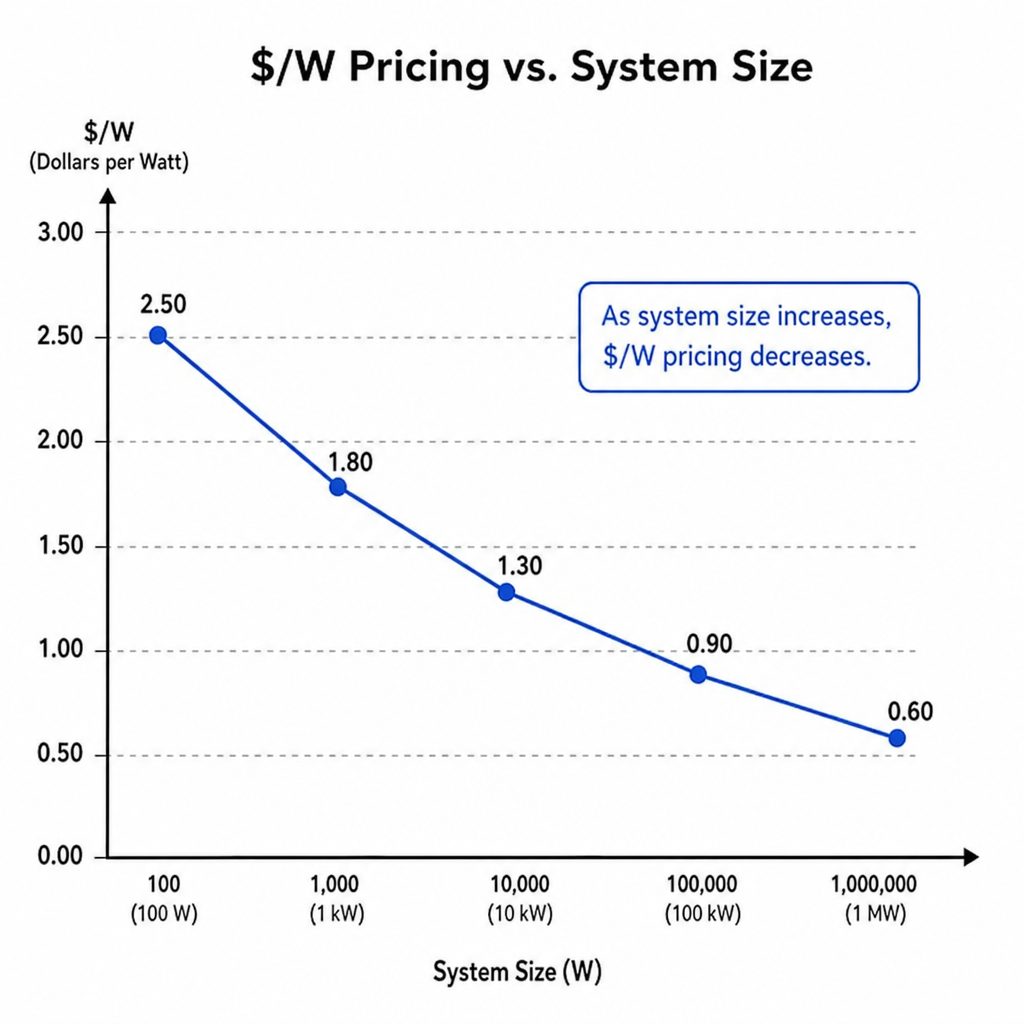
- Smaller systems often cost more per watt (fixed costs are spread over fewer panels).
- Larger systems often cost less per watt (more scale efficiency).
- Premium equipment and batteries raise the total, but may add long-term value.
To ballpark quickly, estimate your annual kWh usage, your local sunlight (a production estimate) and your target offset (for example 70–110% of your usage). Then validate that estimate with real quotes from local installers.
A common reference size: the 5 kW system
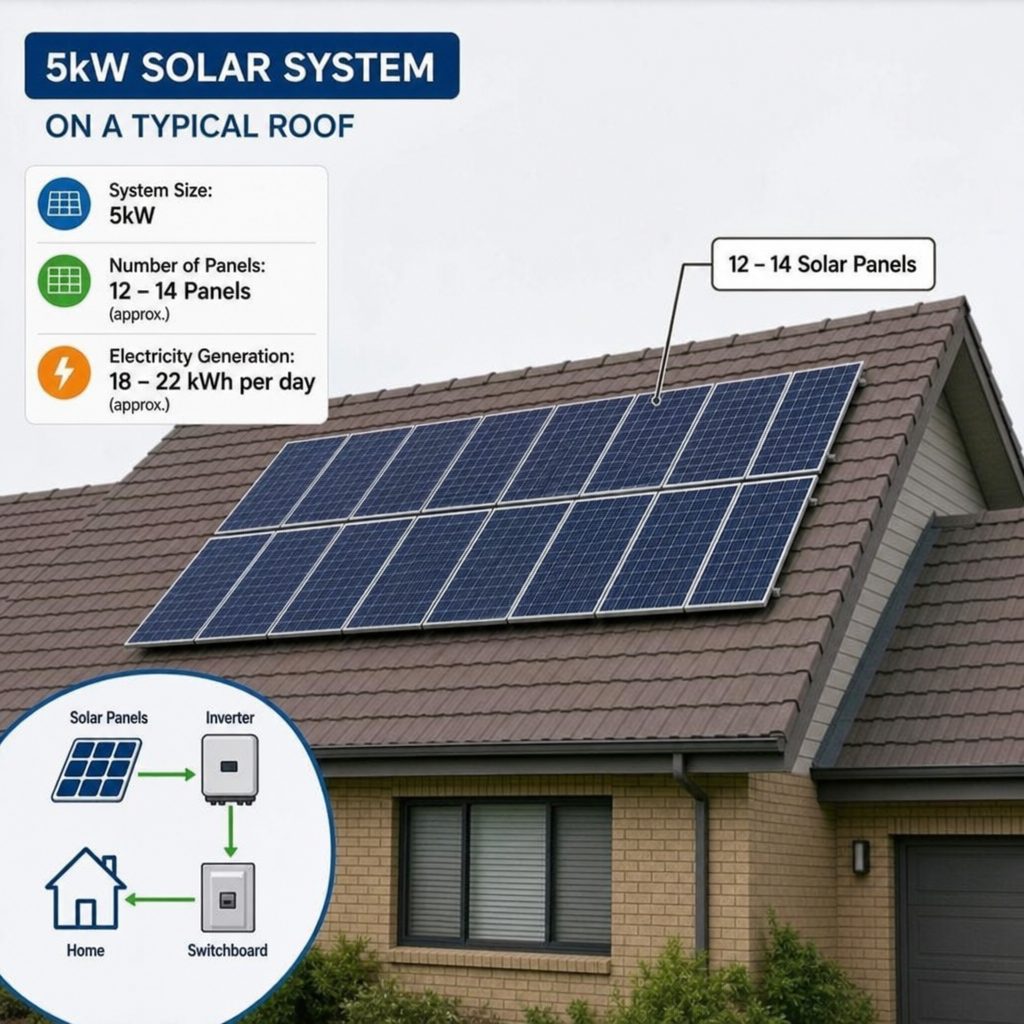
Many homeowners ask about a 5 kW system because it is a common starter size. It can be enough for smaller homes or moderate electricity use, but actual adequacy depends on climate, tariff and usage. When you review quotes around this size:
- Compare the estimated production (kWh per year), not just the price.
- A lower price can be worse value if output is lower due to layout, shading or lower-efficiency equipment.
Tip: ask each installer to show the same assumptions (tilt, orientation, shading losses and degradation). Otherwise you are comparing different “models”, not different prices.
What is included in an installation quote
A full installation quote usually includes:
- Solar panels (modules)
- Inverter(s) (string inverter, microinverters or optimisers)
- Racking and mounting hardware
- Wiring and electrical balance-of-system
- Labour (roof and electrical)
- Permits, engineering and inspections
- Installer overhead and warranty support
Why is solar more expensive than the panel prices you see online?
If you have seen a low panel-only price and wondered why a full system costs so much more, it is because installation is skilled labour (roofing plus electrical), permitting and grid connection take time, safety and code compliance require quality components, and warranties and service are built into the business model. In short, the modules are only one piece of the total.
Equipment choices that change the price
Monocrystalline vs. polycrystalline
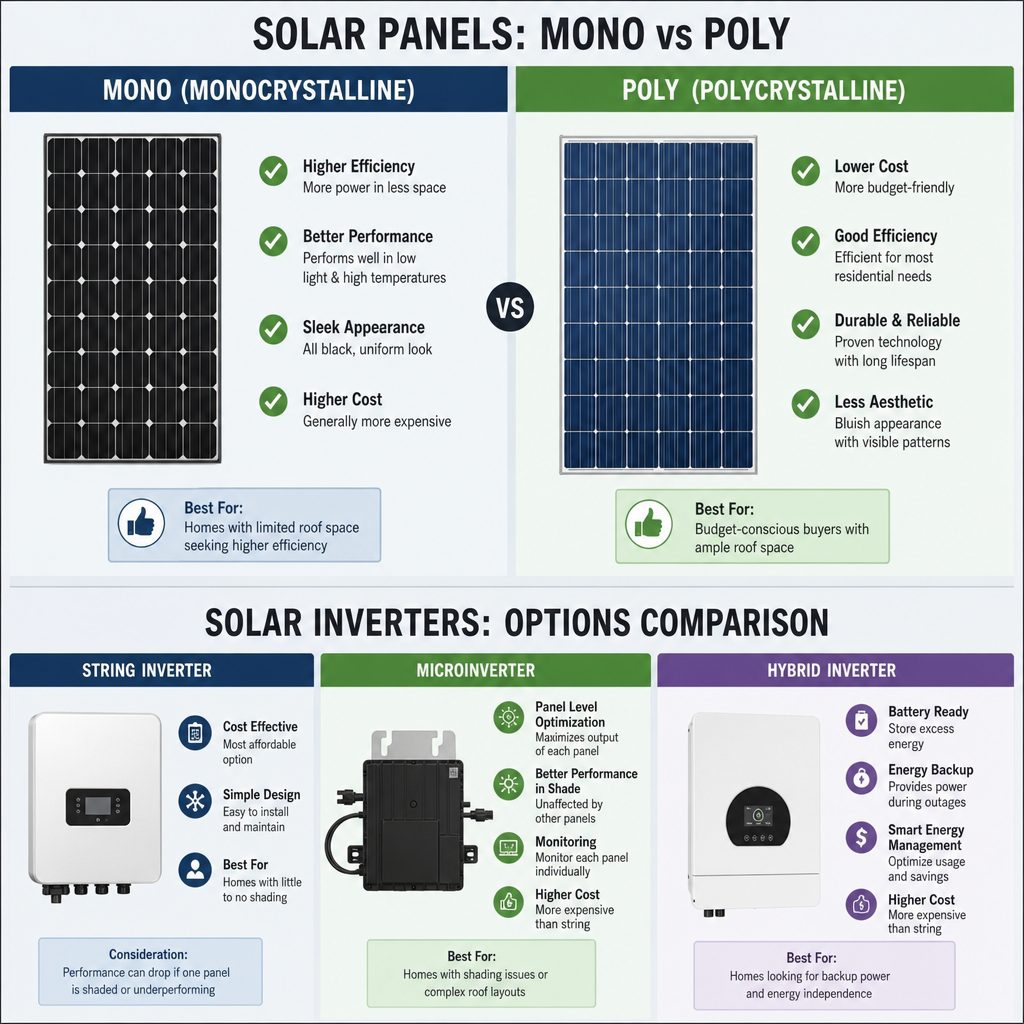
You will often see monocrystalline and polycrystalline panels compared. In today's residential market, monocrystalline is usually favoured because it offers higher efficiency (more power in less roof space), better aesthetics for many homeowners and strong long-term performance. Polycrystalline can still appear in budget proposals but is less common in many regions. The best choice depends on roof space, budget and the installer's supply chain.
Inverter type
The inverter configuration affects shade tolerance, monitoring detail, serviceability and both upfront cost and long-term value. Ask how the proposed inverter design impacts lifetime production and maintenance.
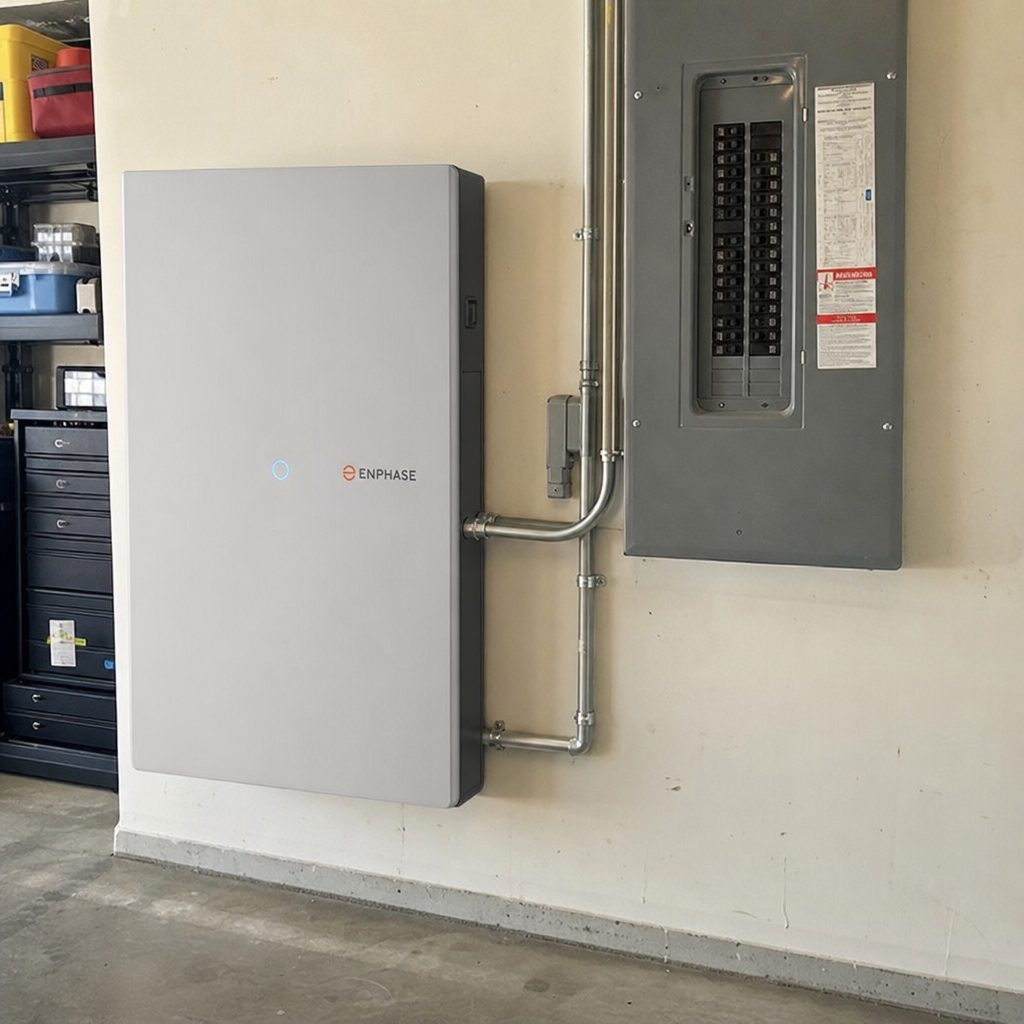
Battery storage: a cost add-on, when it is worth it
Adding a battery can significantly raise your system price. It is most often justified when you want backup power during outages, load shifting (using stored power when grid prices are high) or reduced reliance on the grid. Batteries can be a great upgrade, but do not assume they automatically increase savings — the value depends on your tariff structure, how often outages happen and whether your system can run in backup mode.
Actionable tip: request two quotes from the same installer — solar-only, and solar plus battery (with a clear list of backup loads). This makes the incremental cost and benefit obvious.
Incentives and subsidies: what to confirm
Support schemes can materially reduce the net cost, but they differ by country and region and change over time. Rather than relying on a headline figure, confirm at least:
- Whether your project qualifies, and what form the support takes (grant, low-interest loan, VAT relief, or a feed-in/export payment)
- Which costs count (panels, inverter, labour, and battery where eligible)
- Any application deadlines — several programmes must be applied for before work starts
- When the system must be commissioned to qualify
Because the rules can change and regions add their own programmes, treat your installer's estimate as a starting point and verify it against the official guidance for your area.
Export credits: often the make-or-break variable
Your payback depends heavily on how your grid operator or supplier credits the solar energy you export. Where export or feed-in payments exist, a solid savings estimate should include your current tariff and usage pattern, the value of exported energy (full price vs a lower export rate), and any assumptions about future price changes — clearly labelled as assumptions. If two installers give similar system prices but very different savings projections, ask them to walk through the maths line by line.
Payback period: how to think about returns
Most homeowners want a simple answer: how many years to break even? Your payback period depends on the installed price (after incentives), the annual production (kWh per year), grid prices and their expected rises, any financing terms, maintenance assumptions and whether you include a battery. Good practice is to evaluate solar two ways — a cash purchase (highest long-term return, simplest maths) and a financed purchase (lower upfront cost, but interest affects payback) — then decide which best matches your budget and risk tolerance.
Financing options explained (cash, loan, lease/PPA)
- Cash purchase: the highest ownership benefits and usually the best lifetime savings, but it requires upfront capital.
- Solar loan: you own the system while spreading the payments — watch the fees, interest rate and term, and make sure your expected bill savings exceed the payments.
- Lease or PPA: little or no upfront cost, but savings can be modest depending on the escalators, and you typically do not own the equipment. Scrutinise escalators, transfer terms when selling your home, and buyout options.
How to get better quotes (without wasting time)
Do not just request many quotes — request better ones. Ask each installer for:
- System size (kW) and estimated annual production (kWh)
- The brand and model of panels and inverter(s)
- Warranty details (equipment and workmanship)
- The total price and the price per watt
- The assumptions used for the production modelling
- Any required electrical or roof work, line-itemed
Tip: give the same information to every bidder (annual kWh usage, roof age, photos of the meter box). Consistent inputs produce comparable quotes. On PVFirms you can shortlist verified installers by country before you request quotes.
Reduce your bill even without oversizing
You do not always need the biggest system to cut your bill. You can improve the outcome by:
- pairing solar with efficiency upgrades (LED lighting, insulation, smart thermostats),
- shifting loads to daytime (EV charging at midday, running appliances during solar hours),
- choosing an inverter setup that handles partial shade well,
- sizing the system for your tariff (especially time-of-use plans).
Small planning choices can materially improve savings without changing the system price much.
A simple checklist before you sign
Before committing to an installation agreement, confirm:
- the total installed cost and the payment schedule,
- the expected grid-connection timeline,
- who handles permitting and inspections,
- the roof condition and the penetrations warranty,
- monitoring access (app or platform) and the support process,
- what happens if production is lower than projected.
Takeaway: the right price is about value, not just cost
The best cost outcome is the one that delivers reliable production, solid warranties and realistic savings. Compare prices using the price-per-watt metric, verify the production assumptions, check the incentives that apply in your country, and demand a transparent savings estimate. Do that, and you will be able to judge any solar quote with confidence.
Ready to compare? Find verified solar companies on PVFirms — installers, manufacturers, distributors and consultants across Europe.