Used Solar Panels: How to Buy and Sell Second-Hand Modules Safely in 2026
By PVFirms Editorial Team, Published on 2026-10-24 • 7 min read
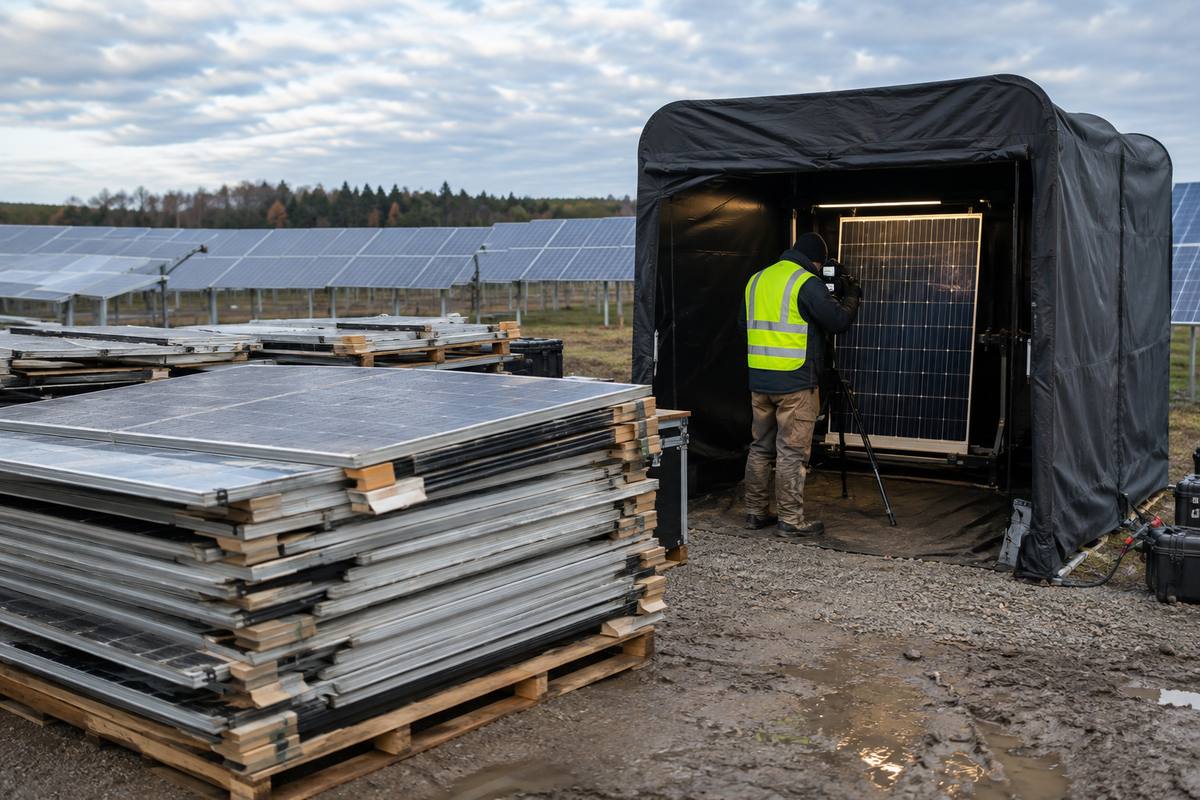
Used solar panels have moved from a niche into a regular trade. Older solar farms are being repowered with higher-wattage modules, insurers write off storm-hit arrays that are only partly damaged, and installers accumulate swapped or returned stock. For buyers, second-hand modules can supply off-grid systems, replace failed modules in legacy strings or keep a budget project viable. For sellers, a documented resale usually beats paying for recycling.
The catch: a used module is worth only what you can prove about it. This guide covers supply, testing, warranties, pricing and waste rules.
In short:
- Most used supply comes from repowering, warranty swaps, insurance claims and decommissioned systems.
- A per-module flash test and electroluminescence (EL) images are the minimum evidence a serious buyer should ask for.
- Manufacturer warranties often do not follow the module to a second owner, so price that risk in.
- In the EU and UK, untested modules shipped in bulk can be treated as waste, so document functionality before the sale.
Where second hand solar panels come from
The source of a batch tells you a lot about its likely condition and paperwork.
- Repowering. Owners of plants built in the early 2010s swap older 60-cell modules, often in the 200–300 W range, for modern high-wattage modules to get more energy from the same land and grid connection. The removed modules usually still work but carry a decade or more of field ageing.
- Warranty and recall swaps. Modules replaced under a claim may be fine, or may belong to a batch with a known defect. Ask why they were removed.
- Insurance write-offs. After hail or storm damage, whole arrays are sometimes replaced even when part of the field is intact. Hail can leave microcracks that are invisible to the eye, so EL testing is essential here.
- Decommissioned rooftops. Demolitions and roof refurbishments release smaller, often mixed lots.
Unused stock from cancelled projects is a different category. Our guide on how to sell excess solar inventory covers that side of the market.
Buy used solar panels only with test evidence
A label tells you what a module produced when it left the factory. Tests tell you what it produces now. The table shows what to request before agreeing a price.
| Test | What it reveals | What to ask the seller for |
|---|---|---|
| Visual inspection | Broken glass, delamination, backsheet cracks, burn marks, corroded frames, damaged junction boxes | Photos of front, back, label and junction box for a sample of modules |
| Flash test (IV curve at standard test conditions) | Actual peak power versus nameplate, mismatch within the lot | Per-serial report with Pmax, Voc, Isc, test date and test equipment details |
| EL imaging | Microcracks, inactive cell areas, broken fingers, PID patterns | EL image per module, or for an agreed statistical sample |
| Insulation and wet leakage test | Safety faults, moisture ingress | Results with the pass threshold stated |
For large lots, agree acceptance criteria in writing before delivery. An example: modules must reach a minimum share of nameplate power, show no crack category above an agreed level on EL, and pass insulation testing. Anything that fails is credited or returned.
Compatibility matters too. For string replacements, match Voc, Isc and the inverter's voltage window, and check frame dimensions against existing clamps.
Warranties on second-hand modules
Crystalline modules typically carry a product warranty of 10–15 years on older generations and a linear performance warranty of 25 years or more. On paper, a ten-year-old module may still have years of performance cover left. In practice, many warranty terms are tied to the original purchaser or installation, require installation by a qualified professional, or exclude modules that have been removed and reinstalled. Some manufacturers from the 2010s have also left the market, which is why the Tier-1 label says little about a warranty's real value a decade later.
The safe working assumption is that used modules carry no manufacturer warranty unless the seller provides written confirmation from the manufacturer. What a buyer can negotiate instead is a contractual guarantee on the test results, a short seller warranty against dead-on-arrival units, and a clear returns process.
How used module prices are set
There is no published index for used modules, so prices are negotiated against a few anchors.
- The new-module ceiling. New module prices fell sharply between 2023 and 2025. A buyer will always compare a used offer with new modules that come with full warranties, which caps what used stock can fetch.
- Measured, not nameplate, watts. Serious offers are priced per measured Wp from the flash test.
- Batch uniformity. Large lots of one model and power class are worth more than mixed pallets, because strings need matching modules.
- Legacy-spare demand. Owners of older plants needing an exact replacement model may pay above market.
- Logistics. Proper pallets, edge protection and a clear collection point add value.
- The disposal floor. A seller who cannot sell pays for recycling, so even a modest price is rational.
Refurbished solar panels: what the label should mean
"Refurbished" is not a standardised term. It can mean cleaned and retested, or physical repair such as new connectors, bypass diodes or backsheet coatings, where long-term durability data is still limited. Ask what was done, by whom, and whether the module was retested afterwards. Confirm with your insurer that repaired modules are acceptable.
WEEE rules and cross-border shipments
In the EU, PV modules fall under the WEEE Directive (2012/19/EU), and the UK applies equivalent WEEE regulations. A module sold for reuse is a product rather than waste, but authorities expect evidence. The Directive sets minimum requirements for shipments of used equipment, which include records showing each item has been evaluated or tested, protective packaging and supporting documents. Bulk loads of untested modules risk being treated as an illegal waste shipment, particularly on exports outside the EU or OECD. Modules that fail testing should go to an authorised treatment facility. Requirements vary by country, so check current rules with your national environment regulator before you ship.
Sell used solar panels: preparing a lot
A seller who prepares well gets better offers and fewer disputes:
- build an inventory list by model, serial number and measured power;
- test the whole lot or an agreed sample, and separate failures before listing;
- photograph labels, junction boxes and pallets;
- store modules dry, with edge protection;
- state delivery terms and keep removal records for WEEE paperwork.
Trading used modules on the PVFirms Marketplace
The PVFirms Marketplace lets verified companies list used and surplus modules, inverters, batteries, mounting systems and spare parts. Browsing is free, posting is free for verified companies, and PVFirms takes no commission. Buyers and sellers deal directly, and PVFirms does not handle payment, shipping or escrow. That is why test evidence matters: attach flash test reports, EL images and, where available, yield history from the original site.
Sellers start by completing company verification, which confirms identity, registration and at least one live customer. Buyers can check the seller's tier, request the documents above and agree payment after inspection. If you would rather buy new stock, the distributor and components directory lists wholesalers by country.
FAQ: used solar panels
Are used solar panels worth buying?
They can be, for the right use. Off-grid systems, agricultural buildings and replacements in legacy strings are typical fits. The value depends on tested condition, batch uniformity and how the price compares with new modules carrying full warranties. Without flash test and EL evidence, the saving is rarely worth the risk.
How much power do old solar panels lose?
Crystalline modules typically lose around 0.5% of output per year, with somewhat higher rates on some older or lower-quality products. A ten-year-old module in good condition might therefore deliver roughly 93–96% of its original rating. Only a flash test tells you the real figure. Our guide to how long solar panels last explains the ageing mechanisms.
Do second-hand solar panels come with a warranty?
Rarely a usable manufacturer warranty. Many terms are tied to the first owner or exclude reinstalled modules, and some brands no longer exist. Negotiate a seller guarantee on the test results and a returns process for dead-on-arrival units instead, and get both in writing.
Can used solar panels be exported outside Europe?
Yes, if they travel as functional products with test records, protective packaging and supporting documents. Untested bulk loads risk being classed as waste. Check current requirements with the exporting country's environment regulator before booking freight.
Ready to buy or list a batch?
Browse current listings on the PVFirms Marketplace, or apply for free verification to post your own modules without commission. For context on sourcing new modules alongside used stock, see our overview of solar panel wholesale suppliers in Europe.