Battery Energy Storage System (BESS) Guide: Use Cases, Sizing and Safety for 2026
By PVFirms Editorial Team, Published on 2026-10-24 • 7 min read
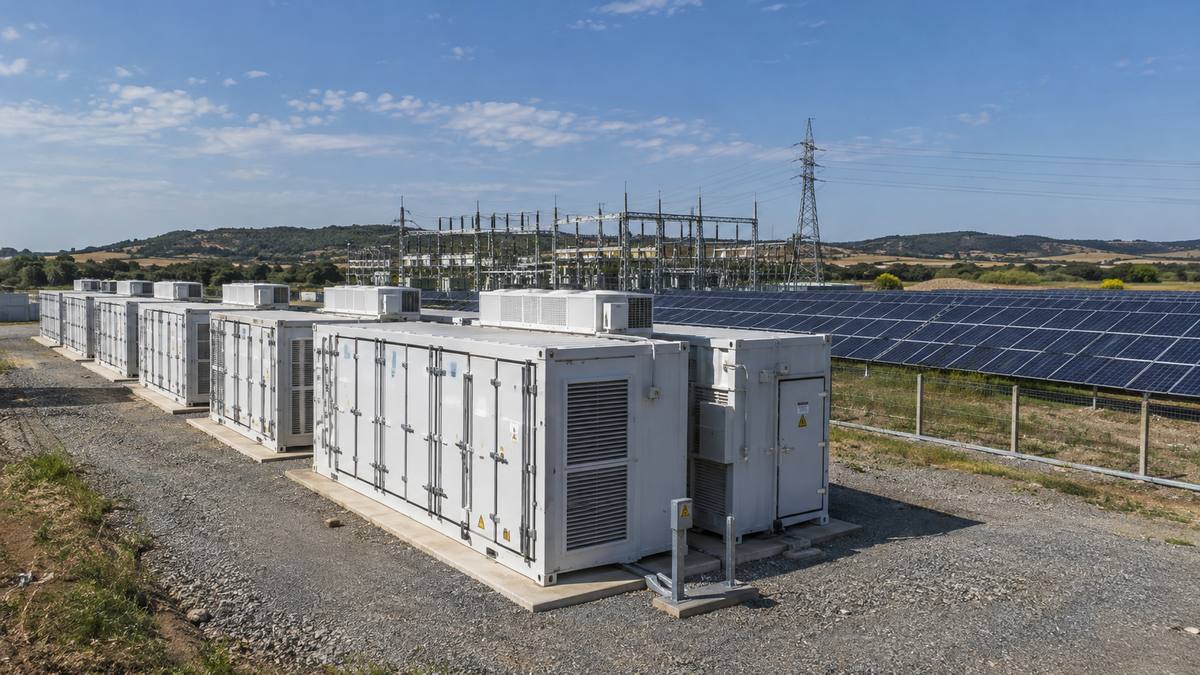
A battery energy storage system stores electricity when it is cheap or plentiful and releases it when it is worth more. In 2026, BESS projects range from a few hundred kWh behind a factory meter to grid assets of hundreds of MWh that trade in wholesale markets and sell services to system operators. For solar owners, co-located storage is increasingly how revenue is protected as midday prices fall.
This guide is for energy managers, developers and asset owners weighing commercial battery storage or utility-scale battery storage in Europe, the UK and the US. It covers use cases, power and energy sizing, chemistry, the safety standards that matter and how to choose a BESS integrator.
In short:
- Start from the use case: peak shaving, arbitrage, ancillary services and solar co-location each need a different ratio of power to energy.
- Specify both MW (power) and MWh (energy). Duration equals MWh divided by MW.
- Lithium iron phosphate (LFP) dominates new stationary projects thanks to its thermal stability and cycle life.
- Ask for large-scale fire test evidence such as UL 9540A and confirm which installation codes apply at your site.
What sits inside a BESS
Cells are assembled into modules and racks, supervised by a battery management system (BMS) that tracks voltage, temperature and state of charge. A power conversion system (PCS), essentially a bidirectional inverter, connects the DC batteries to the AC grid. An energy management system (EMS) decides when to charge and discharge. Around these sit thermal management (air conditioning or liquid cooling), fire detection and suppression, switchgear, a transformer and, at scale, containerised enclosures.
The integrator combines these parts and takes responsibility for system-level performance and safety. That is why integrator choice matters more than cell brand alone.
BESS use cases and where the value comes from
| Use case | Typical duration | Source of value | Typical owner |
|---|---|---|---|
| Peak shaving | 1–2 h | Lower demand or capacity charges | Industrial or commercial site |
| Solar self-consumption | 2–4 h | Shifting midday PV into the evening | C&I site with rooftop solar |
| Energy arbitrage | 1–4 h | Buying low, selling high in wholesale markets | IPP, utility, trader |
| Ancillary services | 0.5–2 h | Payments for fast frequency or reserve response | Grid-scale owner |
| Solar co-location | 2–4 h | Time-shifting, less curtailment, shared grid connection | Solar farm owner |
| Backup and resilience | Site-specific | Avoided outage costs | Hospitals, data centres, process industry |
Services and market names differ by country. Great Britain has frequency response products procured by NESO and a Capacity Market; continental Europe uses reserves such as FCR and aFRR; US projects earn revenue in organised markets run by ISOs and RTOs. Most merchant projects stack several revenue streams, so check that the battery warranty allows the cycling this implies.
Sizing: MW, MWh and usable capacity
Power (MW) is the maximum charge or discharge rate, limited by the PCS and the grid connection. Energy (MWh) is how long that power can be sustained. Three factors separate nameplate from usable energy:
- Depth of discharge. Systems reserve part of the capacity to protect the cells.
- Round-trip efficiency. Typically around 85–90% AC-to-AC for modern LFP systems.
- Degradation. Capacity fades with cycles and time, so either oversize initially or plan augmentation.
Illustrative example: a factory peaks at 1.5 MW during a two-hour afternoon window and wants to cap demand at 1.0 MW. It needs 0.5 MW of discharge power and about 1.0 MWh of usable energy. Allowing for a reserved state-of-charge band and degradation headroom, the specification might call for roughly 1.25 MWh nameplate. An engineer should confirm this against interval data.
For solar co-location, choose between DC coupling, which shares the PV inverter and captures clipped energy, and AC coupling, which is simpler to retrofit and can charge from the grid. Co-location can also share a single grid connection, often the scarcest asset in a project. Our guide to commercial solar panels explains how load profiles feed into this sizing.
Chemistry: why LFP leads
LFP contains no nickel or cobalt, tolerates higher temperatures before thermal runaway and commonly carries cycle ratings in the thousands. Its lower energy density matters little in a stationary container. NMC offers higher density and appears in earlier projects and some compact C&I units, with a greater thermal risk profile. Sodium-ion is emerging with promising cost and supply-chain characteristics but limited bankable field history in 2026. Flow batteries target longer durations and remain a niche.
Safety standards and codes
- UL 9540: US safety standard for energy storage systems and equipment.
- UL 9540A: test method for thermal runaway fire propagation at cell, module, unit and installation level. Authorities and insurers on both sides of the Atlantic ask for its results.
- NFPA 855: US installation standard covering spacing, size limits, fire protection and explosion control.
- IEC 62933 series: international standards for electrical energy storage systems, including safety of electrochemical systems.
- IEC 62619: safety requirements for industrial lithium cells and batteries.
- EU Battery Regulation (2023/1542): phases in carbon footprint, due diligence and digital battery passport duties for industrial batteries. The passport is scheduled for 2027; verify the timeline for your product category.
In the UK, the National Fire Chiefs Council has published guidance that fire services use when responding to planning applications for grid-scale BESS. Wherever you build, engage the fire service early and agree an emergency response plan.
Choosing a BESS integrator and planning O&M
Score bidders on:
- Operating track record: MWh in service, years of performance data, contactable references.
- Cell supply: named cell manufacturer, supply agreement and traceability.
- Warranty terms: capacity retention curve, throughput or cycle limits, temperature and C-rate conditions, exclusions.
- Performance guarantees: availability and round-trip efficiency, with clear measurement rules.
- Controls: EMS ownership, integration with your optimiser or trader, cybersecurity.
- Grid compliance: testing to the applicable code, such as G99 in Great Britain, national network code requirements in the EU or IEEE 1547 for US distributed resources.
- Long-term service: LTSA pricing, augmentation commitments, spare parts and response times.
Ongoing O&M covers state-of-health monitoring, cell balancing, cooling and fire-system maintenance, firmware updates and timing augmentation before capacity breaches contractual minimums.
Finding BESS companies on PVFirms
As of October 2026, PVFirms lists 137 companies in its Agri-PV and BESS category. Combine it with the EPC and project developer directory for turnkey delivery, and the IPP directory if you want a partner to own and operate the asset. Filter by country, compare verification tiers and send the same specification to each shortlisted firm.
Frequently asked questions
What is the difference between MW and MWh in a BESS?
MW is the rate at which the battery can charge or discharge; MWh is the total energy it can deliver. A 10 MW / 20 MWh system can supply 10 MW for about two hours. Grid services often value power, while arbitrage and solar shifting value energy, so the ratio should follow your revenue plan.
How long does a battery energy storage system last?
Commercial LFP systems are commonly designed for 10 to 20 years of service, depending on cycling, temperature and depth of discharge. Warranties usually guarantee a minimum capacity over a defined period or throughput. Augmentation, adding modules over time, can keep usable capacity at the contracted level for longer.
Can storage be added to an existing solar farm?
Usually, yes. AC-coupled retrofits are the most common route because they leave the PV inverters untouched. You may need a modified grid connection agreement, planning consent and changes to any PPA that defines delivery profiles. Check land rights too, since leases written for solar alone may not cover batteries.
Are there incentives for commercial battery storage?
It depends on the market. Some countries support storage through capacity mechanisms, grid service tenders or investment grants rather than direct subsidies. In the US, federal tax credits for storage were changed by 2025 legislation, including sourcing restrictions, so confirm eligibility on irs.gov. For residential systems, see our home battery comparison.
Shortlist storage partners
Define the use case and interval data first, then compare integrators in the Agri-PV and BESS directory. If the battery will back a long-term offtake contract, read our solar PPA explainer on shaped and baseload deals.