Commercial Solar Panels: A 2026 Business Guide to Costs, ROI and Financing
By PVFirms Editorial Team, Published on 2026-10-24 • 7 min read
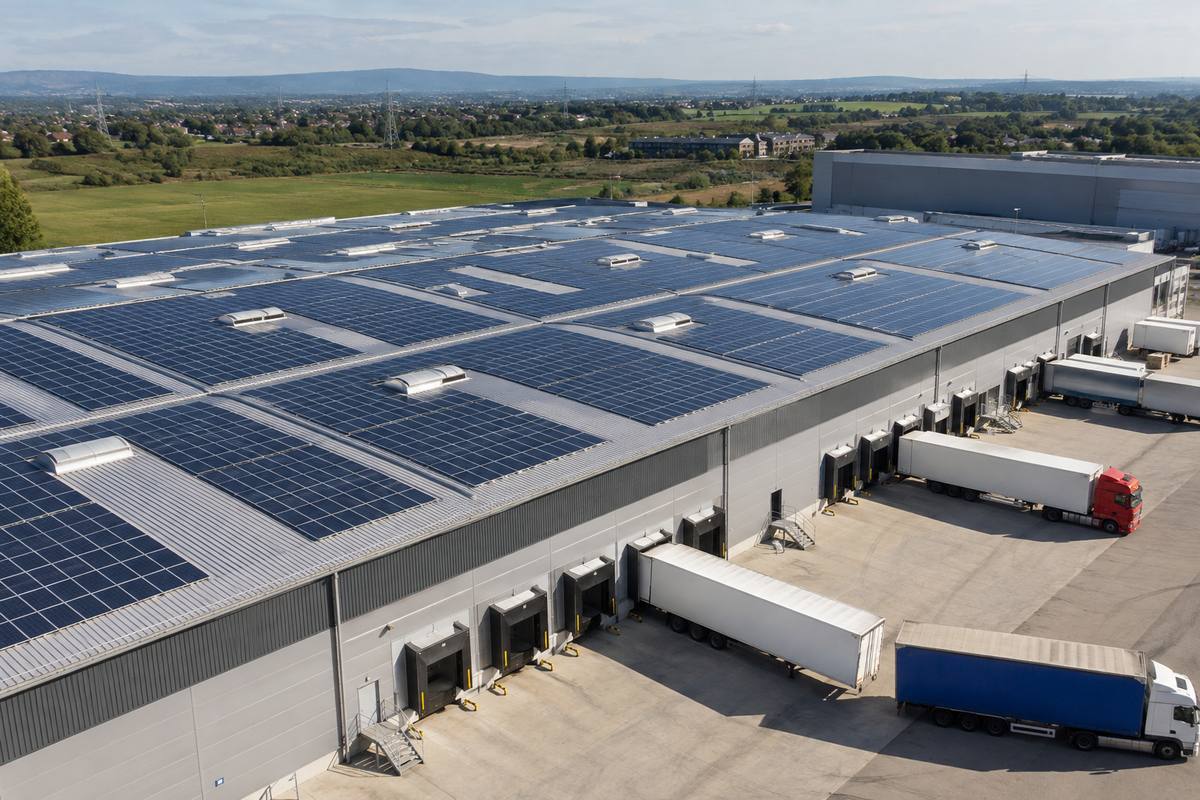
Commercial solar panels turn an idle roof into a 25-to-30-year hedge against electricity prices. For a UK business with a steady daytime load, a rooftop system in 2026 typically costs between about £600 and £1,100 per kWp installed (indicative), and on the assumptions used below, simple payback lands in the 5-to-8-year range. Sites that export most of their output see slower returns.
The gap between a strong and a weak business case rarely comes down to the panels. Load profile, roof condition, grid connection and funding structure decide it. This guide covers each for facilities, finance and procurement teams in the UK, Ireland and the wider EU.
In short:
- Indicative 2026 installed prices for commercial rooftops fall from about £1,100 per kWp on small systems to £600 or less on large ones. Budget separately for grid and roof works.
- Self-consumption drives commercial solar ROI: a kWh used on site is worth several times a kWh exported.
- UK businesses can usually deduct much of the cost early through capital allowances. Confirm the treatment with your accountant.
- On-site PPAs and leases let a third party fund, own and maintain the system if capex is tight.
Commercial solar installation cost: indicative 2026 ranges
The ranges assume a sound roof with reasonable access and include hardware, mounting, design, commissioning and monitoring. They exclude roof repairs, structural work and any network reinforcement required by the distribution network operator (DNO).
| System size | Typical building | Indicative cost per kWp (UK) | Indicative total (UK) |
|---|---|---|---|
| 30–50 kWp | Workshop, small office, farm shed | £900 – £1,100 | £27,000 – £55,000 |
| 100–250 kWp | Mid-size warehouse, school, retail unit | £750 – £950 | £75,000 – £240,000 |
| 250 kWp – 1 MWp | Distribution centre, factory | £650 – £850 | £160,000 – £850,000 |
| Over 1 MWp | Large plant, multi-roof campus | £550 – £750 | Project-specific |
Eurozone prices sit in a broadly similar band once converted. Use them for budgeting only. Four variables move a commercial quote most:
- Roof type. Trapezoidal metal sheeting is usually cheapest. Flat membrane roofs need ballasted or bonded systems; older fibre-cement roofs may need an asbestos survey first.
- Grid connection. In Great Britain, generators above 16 A per phase need a G99 application to the DNO. Where the local network is constrained, reinforcement costs and lead times can reshape the project.
- Electrical works. Long cable runs, new LV panels or a transformer upgrade are often underestimated.
- Insurer requirements. Insurers increasingly set conditions for rooftop PV; the RC62 fire-safety recommendations are a common UK reference. Involve your broker before design freeze.
Commercial solar ROI: what really drives the numbers
Overlay 12 months of half-hourly consumption data with an hourly generation profile for the roof. The overlap is your self-consumption, the most important number in the business case. Every kWh used on site avoids your full delivered unit rate, including network and policy costs; an exported kWh earns a fraction of that. Manufacturing, cold storage and daytime logistics absorb most of their generation; offices closed at weekends absorb less.
A worked example (illustrative only)
A 200 kWp warehouse system at £850 per kWp costs £170,000. At a typical UK yield of 900 kWh per kWp, it generates about 180,000 kWh in year one.
| Scenario | Used on site | Exported | Value at assumed 20p / 5p per kWh | Simple payback |
|---|---|---|---|---|
| Strong daytime load | 85% (153,000 kWh) | 27,000 kWh | ~£31,950 a year | ~5.3 years |
| Weak daytime load | 50% (90,000 kWh) | 90,000 kWh | ~£22,500 a year | ~7.6 years |
The unit values are assumptions, not tariffs; substitute your own contracted rate and export offer. The example ignores tax relief, which shortens payback, and O&M plus an inverter replacement around years 12–15, which lengthen it.
Where demand peaks after sunset, a battery can shift output; see our battery energy storage guide.
Solar for business in the UK: capital allowances in brief
For UK tax purposes, solar panels are generally special rate plant and machinery, which determines the allowances:
- Annual Investment Allowance (AIA). Open to companies and unincorporated businesses, it gives a 100% deduction up to an annual limit and covers special rate assets.
- 50% first-year allowance. Alongside full expensing for main rate plant, companies within corporation tax can claim 50% in year one on new special rate assets such as solar.
- Writing-down allowances. Remaining spend enters the special rate pool and is relieved over time.
Under a PPA or most operating leases, the provider owns the system and claims the allowances. HMRC sets the limits and they can change, so confirm current terms on gov.uk and with your tax adviser. In Ireland, check SEAI for non-domestic supports; our European solar subsidies guide outlines other EU mechanisms.
Funding business solar panels without a big cheque
Outright purchase gives the best lifetime return and keeps the allowances in-house. Asset finance or a green loan preserves ownership while spreading the cost. An operating lease swaps ownership for a fixed monthly payment. With an on-site PPA, a funder installs and operates the system and sells you the electricity at an agreed rate per kWh, typically for 15 to 25 years. You avoid capex and O&M but hand over most of the long-term value. Providers check your credit and want security of tenure, so tenants need landlord consent and a lease that outlasts the contract. Our explainer on solar PPAs compares on-site and off-site structures.
EPC contractor or commercial installer?
For a single roof up to a few hundred kWp on a low-voltage connection, a commercial installer with in-house design and G99 experience is usually the efficient choice. Move to an EPC contractor for multi-MWp sites, high-voltage connections, ground mounting, battery integration, lender involvement or a contractual performance ratio guarantee, where one party carrying design and construction risk pays off.
The PVFirms comparison of EPC contractors and local installers sets out the trade-offs. For the EPC route, our EPC tender checklist covers prequalification and contract terms. Where roof space runs out, a solar carport can add capacity.
Before you tender: site-readiness checklist
- Structural survey confirming the roof can carry the extra dead and wind loads.
- Roof life. If the covering will not last another 25 years, re-roof first.
- Asbestos register for older buildings, plus landlord consent.
- Early G99 application, since connection offers can take months.
- Planning. Many non-domestic rooftop systems in England fall under permitted development, subject to conditions. Listed buildings, conservation areas and the devolved nations differ, so check locally.
- Data pack: half-hourly data, roof drawings and a single-line diagram.
How to shortlist commercial solar companies on PVFirms
As of October 2026, PVFirms lists 267 solar companies in the United Kingdom. Start from UK solar companies, then narrow to installers for single-roof projects or EPC and project developers for larger, more complex sites. Each profile shows its verification tier: Verified means identity, registration/VAT and at least one live customer were confirmed with documents. Search order depends on tier and rating, never payment.
Send the same data pack to three or four bidders through their profiles, free of charge, and ask for cost per kWp, yield estimate, inverter strategy and itemised grid and roof works.
Frequently asked questions
How much do commercial solar panels cost per kWp?
In 2026, indicative installed prices for UK commercial rooftops range from around £1,100 per kWp for 30–50 kWp systems to £600 or below above 1 MWp. Roof type, access, electrical upgrades and grid reinforcement explain most of the spread. Ask bidders to price grid and roof works as separate line items so quotes compare fairly.
What payback should a business expect from solar?
Where most generation is consumed during working hours, simple payback of roughly 5–7 years before tax relief is realistic on current assumptions. Sites exporting half their output or more can take 8 years or longer. Your contracted unit rate matters as much as system price, so model a scenario where wholesale prices fall.
Can we install solar on a leased building?
Yes, with landlord consent. The lease should outlast the expected payback or set clear terms on removal and compensation if you leave early. Some landlords prefer to own the system and sell power to tenants, which gives them roof income and removes your capex.
Is VAT charged on commercial solar in the UK?
Generally yes, at the standard rate. VAT-registered businesses can normally recover it as input tax, so it affects cash flow more than final cost. The zero rate for energy-saving materials covers residential property and certain charitable buildings. Check your position with your accountant.
Plan your commercial solar project
Gather a year of half-hourly data, confirm roof life and lease position, then invite three or four contractors to bid on the same brief. Compare qualified firms in the EPC and project developer directory and request quotes directly from their profiles.