Solar Carports for Business: Costs, Design, Permitting and EV Charging in 2026
By PVFirms Editorial Team, Published on 2026-10-24 • 7 min read
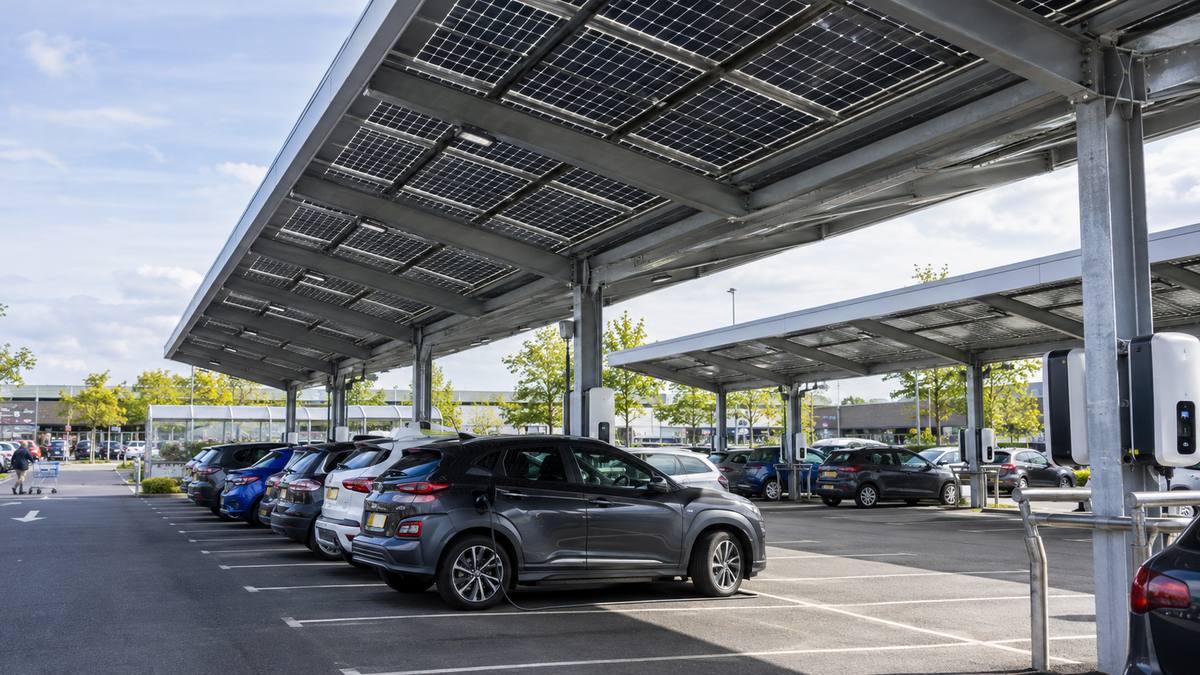
Solar carports turn a car park into a generating asset. They make sense when a building's roof is too weak, too small, leased or simply unavailable, and when the site already has a large, sunny parking area. They also give drivers shade and rain cover, and they provide a ready-made frame for EV chargers.
The trade-off is cost. A rooftop system uses a structure that already exists, while a carport needs its own steel and foundations. This guide covers where solar carports earn their keep, how their cost compares with rooftop solar, the main design and permitting questions in the UK and Europe, and how to integrate EV charging.
In short:
- Solar carports typically cost around one and a half to two and a half times as much per kWp as a commercial rooftop system (indicative, 2026).
- Each parking space typically supports roughly 2.5–3.5 kWp of modules.
- Ground conditions, buried services and canopy design drive most of the cost spread.
- France's APER law requires solar shading on many large car parks, which is reshaping the European carport supply chain.
Where solar carports make commercial sense
The strongest cases share three features: a large open car park, high daytime electricity demand on site, and a plan for EV charging.
- Retail parks and supermarkets, where refrigeration and lighting run all day.
- Offices and business parks, with workplace charging and long parking dwell times.
- Logistics hubs and fleet depots, where vans charge on site.
- Hospitals, universities and public estates, with large car parks and long investment horizons.
Before going further, check two things. First, the land: a carport is a 25-year-plus structure, so you need control of the car park for that period. Second, the alternatives: if a sound roof is available, rooftop capacity is usually cheaper. Our guide to commercial solar panels covers the rooftop route.
Solar carport cost compared with rooftop
Prices below are indicative 2026 ranges for commercial projects. Large, repetitive layouts on easy ground sit at the lower end. Small or architecturally demanding schemes sit at the top or above.
| Item | Commercial rooftop | Solar carport |
|---|---|---|
| Indicative installed cost per kWp (UK) | £600 – £1,100 | £1,100 – £2,000 |
| Indicative installed cost per kWp (eurozone) | Varies by country | €1,000 – €1,900 |
| Supporting structure | Existing roof | New steel, aluminium or timber frame |
| Groundworks | None | Foundations, trenching, resurfacing |
| Typical capacity | Limited by roof area | Roughly 2.5–3.5 kWp per parking space |
| Extras to budget | Roof repairs, access | Lighting, drainage, height barriers, impact protection |
The biggest cost drivers for a solar carport are:
- Ground conditions. Poor soils may need piles rather than pad foundations.
- Buried services. Cables, drains and gas pipes under the tarmac can force posts into awkward positions.
- Canopy design. Cantilevered single-post designs free up space for cars but use more steel than double-post frames.
- Clearance height and loads. Taller canopies for vans, plus local wind and snow loads, increase steel weight.
- Scale. Fixed costs such as design, mobilisation and grid works spread better over larger schemes.
A quick sense check, for illustration only: a car park with 200 spaces at around 3 kWp per space would support roughly 600 kWp.
Design choices for a solar canopy car park
Layout. Single-row canopies suit narrow strips. Double-row Y-frame or butterfly designs cover two rows of bays from one line of posts. Long-span designs reduce the number of posts but cost more per kWp.
Materials. Hot-dip galvanised steel is the most common choice. Aluminium and glued laminated timber appear where weight or appearance matters. Ask what corrosion protection is specified, especially near roads that are salted in winter.
Foundations. A ground investigation and a buried-services survey are essential before final design. Foundations may be bored piles, pad footings or ground screws.
Modules and water. Glass-glass modules are widely used on canopies. Decide whether the canopy must be watertight, which needs gutters and sealing, or whether rain can drip between modules. Semi-transparent glass-glass modules let daylight through, which some retail and public schemes prefer. PVFirms' overview of BIPV manufacturers and suppliers in Europe covers these products.
Safety. Plan for vehicle impact protection on posts, fire service access, lighting under the canopy and DC isolation. Involve your insurer early, because requirements vary.
Permitting solar carports in the UK and Europe
United Kingdom. In England, solar canopies on non-domestic car parks have historically needed planning permission. Permitted development rights covering some solar canopies in non-domestic car parks have since been introduced, with limits on siting and size. Check the current conditions with your local planning authority, and note that Scotland, Wales and Northern Ireland have their own rules. Grid connection follows the network operator's process, typically under G99 for commercial-scale systems.
Elsewhere in Europe. Requirements range from a simple notification to a full building permit, depending on the country and municipality. Structural design normally follows the Eurocodes for wind and snow loads.
France and the APER law. France's 2023 law on accelerating renewable energy (loi APER) requires many outdoor car parks above 1,500 m² to cover at least half their surface with shading that includes renewable generation, with phased deadlines for existing car parks and exemptions for technical, safety or economic reasons. Deadlines and exemptions depend on implementing rules, so check current terms with the official service-public.fr guidance. For the wider market, the law signals sustained demand for carport structures and installers across Europe, which affects lead times and pricing.
Integrating EV charging with commercial solar parking
A canopy is the natural cable route for EV chargers, so plan ducts and charger positions before the foundations are poured.
- Match the profile. Workplace parking overlaps well with daytime generation. Short-stay retail parking favours faster chargers, where solar covers only part of the energy.
- Check grid capacity. Chargers and a PV system share one connection. Dynamic load management, and sometimes a battery, can avoid an expensive upgrade. Our battery energy storage guide explains the options.
- Meter separately. Separate metering for chargers simplifies billing to staff, tenants or the public.
For the basics of pairing solar with vehicles, see our article on charging an electric car with solar panels.
Building a carport supplier shortlist
Carport projects usually involve a specialist structure supplier, a module manufacturer, an electrical contractor and an EV charging installer, coordinated by an EPC or commercial installer. On PVFirms, start with the EPC and project developer directory for delivery partners, the BIPV category for glass-glass and semi-transparent canopy products, and the manufacturer directory for modules and mounting structures. Each profile shows the company's verification tier.
When you tender, ask for structural calculations based on your site investigation, a phased programme that keeps part of the car park open, and the corrosion warranty on the structure. Our EPC tender checklist covers contract terms in detail.
FAQ
How much does a solar carport cost per parking space?
As an illustration, at around 3 kWp per space and an indicative £1,100–£2,000 per kWp, one space costs roughly £3,300–£6,000 in the UK before EV chargers. Large schemes on easy ground can come in lower. Difficult foundations, tall clearances or bespoke designs push the figure higher.
Are solar carports worth it compared with rooftop solar?
Per kWp, rooftop is usually cheaper. Carports win when the roof is unsuitable or too small, when the site needs EV charging, or when shade and rain cover add value for customers and staff. Compare the cost per kWh over the system's life, not just the upfront price.
Do solar carports need planning permission in the UK?
Often, yes, although England has introduced permitted development rights for some solar canopies in non-domestic car parks, subject to limits. Scotland, Wales and Northern Ireland have separate rules. Confirm the position with your local planning authority before committing to a design.
Can solar carports charge electric vehicles directly?
In most schemes the PV system and the chargers connect to the same site electrical system, so solar power feeds the chargers whenever both are running and the grid covers the rest. Direct DC-coupled designs exist but are less common. Load management decides how much solar actually reaches the vehicles.
Scope your car park
Measure the usable parking area, gather your half-hourly or interval consumption data and map any buried services. Then compare delivery partners in the PVFirms EPC and project developer directory and request proposals.