How to Charge an Electric Car with Solar Panels: The Maths, the Chargers and the Tariffs
By PVFirms Editorial Team, Published on 2026-10-24 • 7 min read
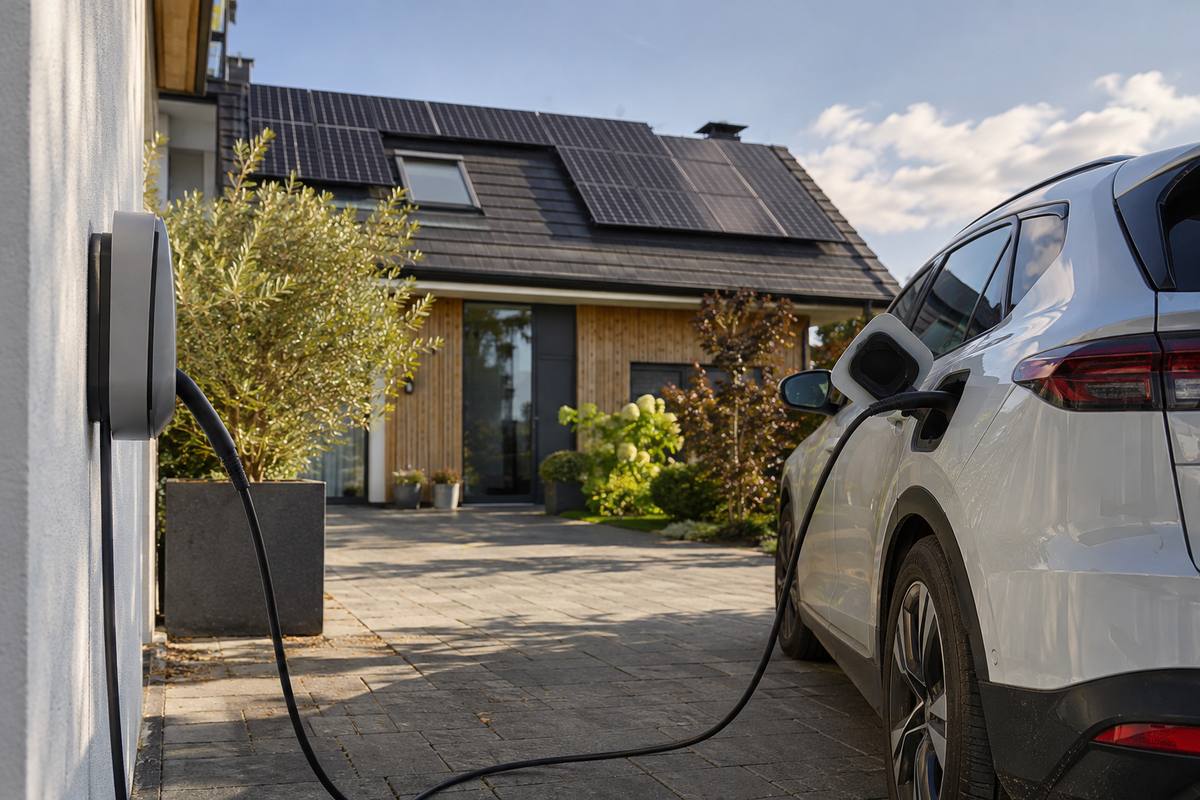
Yes, you can charge an electric car with solar panels, and a typical home array produces enough energy over a year to cover a lot of everyday driving. The catch is timing. Panels generate in the middle of the day, while many cars sit at work or charge overnight.
This guide works through the numbers, explains how solar-aware chargers behave, and helps you decide when solar charging beats a cheap overnight tariff.
In short:
- A typical EV covers roughly 3–4 miles per kWh, so 7,500 miles a year needs around 2,000–2,500 kWh, including charging losses.
- In the UK and Ireland that is roughly 2.5–3 kW of panels over a year; in sunnier US states, noticeably less.
- A solar EV charger only uses surplus once it exceeds about 1.4 kW, the minimum most cars accept on a single-phase supply.
- If your car is rarely home in daylight, a cheap overnight tariff may matter more than solar timing.
The maths: how many solar panels to charge an EV
Start with your mileage and your car's efficiency. Most modern EVs manage around 3–4 miles per kWh (roughly 16–21 kWh per 100 km), and home AC charging typically loses about 10% along the way.
The table uses 3.5 miles per kWh plus 10% losses. UK and Ireland figures assume a typical yield of about 900 kWh per kW of panels per year; the US column assumes an illustrative 1,400 kWh per kW for a sunnier location. Panel counts assume 430 W modules.
| Annual mileage | Energy needed per year | Solar needed, UK/IE | Solar needed, sunny US |
|---|---|---|---|
| 5,000 miles | ~1,600 kWh | ~1.8 kW (4–5 panels) | ~1.1 kW (3 panels) |
| 7,500 miles | ~2,400 kWh | ~2.6 kW (6 panels) | ~1.7 kW (4 panels) |
| 10,000 miles | ~3,100 kWh | ~3.5 kW (8 panels) | ~2.2 kW (5 panels) |
| 12,000 miles | ~3,800 kWh | ~4.2 kW (10 panels) | ~2.7 kW (6–7 panels) |
These are annual totals; your panels also run the house, and winter output is a fraction of summer's. Treat the table as a guide to the extra capacity the car justifies, then use our guide to how many solar panels you need to size the whole system.
How a solar EV charger works
A solar-aware charger measures what your panels produce and what the house uses, usually via a clamp on the incoming supply cable or a link to the inverter, and matches the charging rate to the surplus.
Most offer three modes:
- Solar only: charges purely from surplus and pauses when a cloud passes.
- Hybrid: tops up the minimum rate from the grid and adds solar on top, so charging never stalls.
- Fast: full power regardless of the sun.
There is one physical limit. Cars generally need at least 6 amps to start charging: about 1.4 kW on a single-phase supply, or around 4.1 kW on three-phase, although some chargers can switch phases. With a 3–4 kW array, the kettle and a passing cloud can easily push surplus below that threshold, which is why hybrid mode is popular.
In Great Britain, home chargers sold since 2022 must meet smart charging regulations, including default off-peak settings you can change. Your installer will also check that your main fuse and consumer unit can take the extra load.
Daytime solar or overnight grid: which is cheaper?
Every solar kWh you put into the car is one you could have exported. So compare two numbers:
- What a surplus solar kWh is worth to you. In the UK that is your Smart Export Guarantee rate. In Ireland it is your Clean Export Guarantee rate. In the US it depends on your utility's net metering or net billing rules.
- Your cheapest import rate. Many suppliers offer EV or time-of-use tariffs with low overnight prices.
If your export rate is lower than your cheapest overnight rate, charging from solar wins. If it is higher, exporting at midday and charging overnight can be the better deal. Under full retail net metering, timing matters much less financially. Under net billing schemes such as California's, where exports earn far less than imports, solar charging becomes more valuable. Rates change often, so redo the comparison when you switch tariff.
Whose driving pattern suits solar charging?
Solar EV charging at home works best if the car is parked in daylight: home workers, retirees, shift workers and households with a second car. Commuters can still capture weekend and summer-evening sun, but should expect overnight charging to do most of the work.
Using a home battery as a buffer
A home battery can store midday surplus and release it later, but it is rarely the best way to fill a car:
- Size mismatch. A home battery typically holds 5–15 kWh; an EV battery is often 40–80 kWh or more. One session can drain the home battery and leave the house buying peak-rate power.
- Losses. Panel → battery → car involves more conversions than panel → car.
- Better roles. Let the car take surplus directly in daylight, and the battery cover the house in the evening.
Bidirectional charging (vehicle-to-home or vehicle-to-grid) is emerging but needs a compatible car and charger, so check with the manufacturer first. Our guide to solar battery storage explains how batteries are sized and priced.
Setting up solar EV charging at home: a checklist
Use this list when you talk to installers:
- Existing solar: does your inverter or energy meter talk to the charger you want, or will you need a supply clamp?
- Supply capacity: is your main fuse adequate, or will you need an upgrade from the network operator?
- Charger location: cable runs, outdoor rating and tethered or untethered.
- Single or three phase: this sets the minimum solar surplus needed.
- Tariff: is there an EV tariff from your supplier that works with your charger?
- Incentives: some UK, Irish and US programmes support home chargers for certain households. Check gov.uk, SEAI or your state and utility for current terms. In the US, the federal homeowner solar credit has changed; see our guide to the 2026 solar tax credit.
As an indicative 2026 guide, a smart charger installed in the UK typically costs around £800–£1,200, with solar-aware models in the same range or slightly above. Fuse or consumer unit upgrades add to that.
Finding an installer who handles solar and EV charging
The simplest route is one installer for both the panels and the charger, so the clamp, inverter and charger settings are configured together. On PVFirms you can browse the installer directory or the wider solar company directory, then narrow down by country, such as the UK, Ireland or the United States. Profiles show services offered and verification tier, and requesting a quote is free.
If you are curious about solar built into vehicles themselves, PVFirms also lists vehicle-integrated PV companies. For now, the extra range from on-car panels is modest, so a rooftop array remains the practical choice for most drivers.
Frequently asked questions
Can I charge my EV directly from solar panels without the grid?
In a normal grid-connected home, the charger draws from your house supply, which solar feeds first and the grid tops up. Charging purely off-grid is possible but needs a large array, a sizeable battery and a suitable inverter. For most households a grid-tied system with a solar-aware charger is far cheaper and more reliable.
Will solar panels charge my car on a cloudy day?
Yes, but slowly. Panels still produce under cloud, just much less. If surplus drops below about 1.4 kW, solar-only mode pauses; hybrid mode keeps going by drawing the minimum from the grid and adding whatever solar is available. On dull winter days, expect most of the energy to come from the grid.
Is a solar EV charger worth the extra cost?
If you already have solar, or plan to, and your car is often home in daylight, a solar-aware charger is usually worth it because the price gap with a standard smart charger is small. If the car is almost always away during the day, a standard smart charger on an overnight EV tariff may serve you just as well.
Can I charge my car with solar power at night?
Only indirectly. You could store daytime surplus in a home battery and transfer it overnight, but the battery is usually too small and the losses add up. On a net metering arrangement, daytime exports may offset night-time charging on your bill, which achieves a similar financial result.
Plan your solar charging setup
Work out your annual mileage, check your current tariff and export rate, then ask installers to quote for panels and a solar-aware charger together. Start your shortlist in the PVFirms installer directory and request quotes for free.