How Many Solar Panels Do I Need? A Step-by-Step Sizing Guide with Worked Examples
By PVFirms Editorial Team, Published on 2026-10-24 • 7 min read
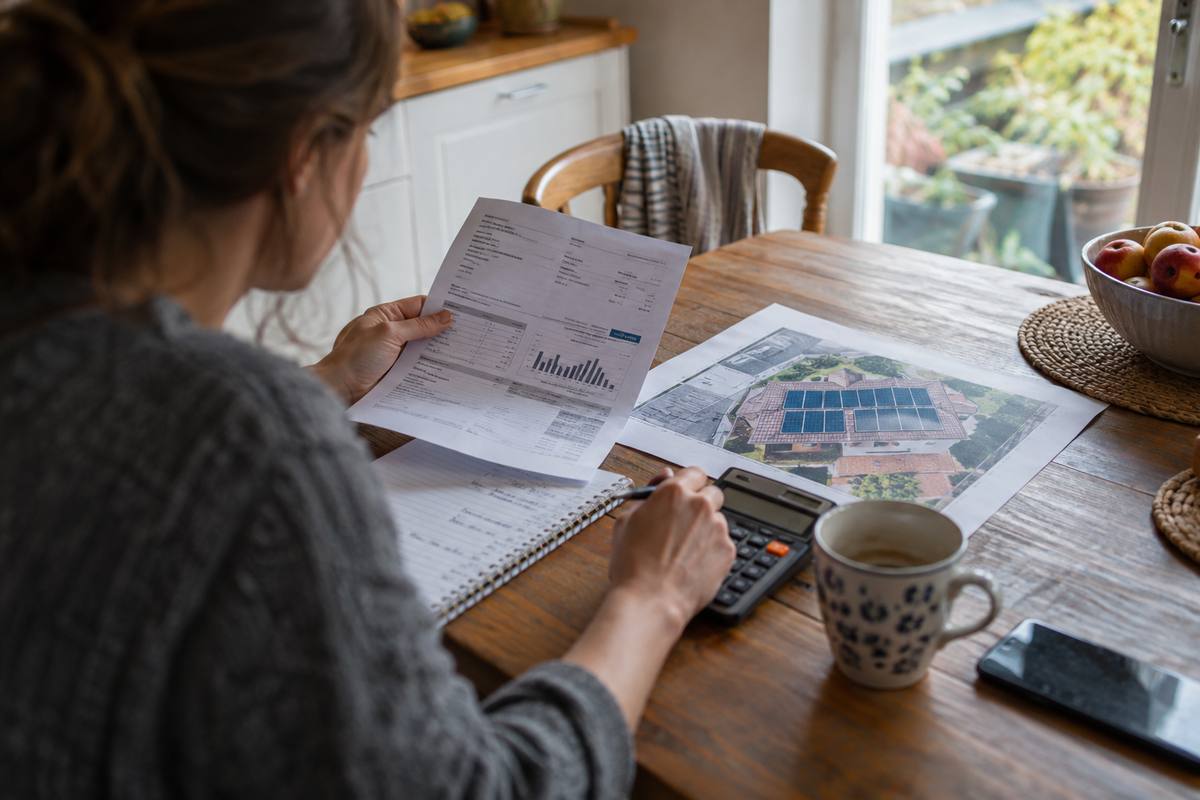
Most homes in the UK and Ireland end up with somewhere between 8 and 14 panels, while many US homes need 15 to 30 or more. The range is wide because the answer to "how many solar panels do I need" rests on three numbers: how much electricity you use, how much each kilowatt of panels generates where you live, and how much usable roof you have.
With a year of electricity bills you can produce a sound estimate in about ten minutes. The five steps below take you from annual kWh to a panel count, then test the result against your roof. Use it to sense-check installer quotes, not to replace a site survey.
In short:
- Panel count ≈ annual kWh target ÷ local yield per kWp ÷ panel rating in kW.
- Most home panels in 2026 are rated around 400–450 W and take up roughly 2 m² each.
- Typical yields run from about 750 kWh per kWp a year in Scotland to well over 1,500 in the US Southwest (indicative).
- Roof space, shading and grid limits often cap the system before your usage does.
Step 1: Find your annual electricity use
Look for the annual consumption figure on a recent bill or in your supplier's app. UK and Irish suppliers usually show an estimated yearly total in kWh. In the US, add up twelve monthly figures from your utility bills, because air conditioning or electric heating can swing usage a lot between seasons.
Then adjust for what is coming. An electric car can add a couple of thousand kWh a year or more, and a heat pump can add several thousand. If either is planned within a few years, size for it now. Adding panels later usually costs more per panel than fitting them at the start. Our guides to charging an electric car with solar and running a heat pump with solar show how those loads change the picture.
Step 2: Choose how much you want to offset
You do not need to aim for 100%. Solar produces mostly in daytime and mostly in summer, so even a system that matches your annual usage will still import on winter evenings and export on summer afternoons.
Three common approaches:
- Match annual usage. Popular where net metering or a decent export tariff credits your surplus.
- Fill the best roof face. Many UK and Irish installers recommend this because each extra panel adds little to fixed costs such as scaffolding.
- Size for daytime use. A smaller system aimed at what you consume while the sun is up suits homes where export is poorly paid.
Step 3: Look up the yield for your area
Yield is how many kWh one kilowatt-peak (kWp) of panels produces in a year. It depends on latitude, climate, roof direction and tilt. These are typical ranges for an unshaded, south-facing roof:
| Region | Typical yield (kWh per kWp per year) |
|---|---|
| Southern England | 900 – 1,050 |
| Midlands, Wales, northern England | 820 – 950 |
| Scotland | 750 – 880 |
| Ireland | 780 – 950 |
| US Northeast and Pacific Northwest | 1,050 – 1,300 |
| US Midwest and Southeast | 1,200 – 1,450 |
| US Southwest | 1,500 – 1,800 |
East- or west-facing roofs typically produce roughly 15–20% less than due south. Your installer should calculate a site-specific figure, using the MCS method in the UK or a tool such as NREL's PVWatts in the US.
Step 4: Convert to system size and panel count
The maths takes two lines:
- System size (kWp) = annual kWh target ÷ yield per kWp
- Number of panels = system size in watts ÷ panel wattage
A home targeting 3,600 kWh a year in the Midlands, with a yield of 900, needs 4 kWp. With 430 W panels that is 4,000 ÷ 430 ≈ 9.3, so 9 or 10 panels.
kWh per solar panel
Thinking per panel makes quick checks easier. A 430 W panel is 0.43 kWp, so multiply that by your local yield:
- Southern England (≈1,000): about 430 kWh per panel a year
- Scotland (≈800): about 345 kWh
- US Southwest (≈1,650): about 710 kWh
Divide your annual target by that figure and you have your panel count directly.
Worked examples
The households below are illustrative, using 430 W panels and a yield from the table above.
| Household | Annual target | Yield | System size | Panels | Panel area* |
|---|---|---|---|---|---|
| 2-bed terrace, Manchester | 2,700 kWh | 880 | 3.1 kWp | 7–8 | ~16 m² |
| 4-bed detached, Kent, with EV | 6,000 kWh | 1,000 | 6.0 kWp | 14 | ~28 m² |
| 3-bed semi, Cork | 4,200 kWh | 900 | 4.7 kWp | 11 | ~22 m² |
| 4-bed house, Ohio | 10,500 kWh | 1,250 | 8.4 kWp | 19–20 | ~430 sq ft |
| 3-bed house, Arizona | 12,000 kWh | 1,650 | 7.3 kWp | 17 | ~365 sq ft |
*Panel area only. Real roofs need extra room for edge clearances and access.
Step 5: Check your roof space
A typical 430 W panel measures roughly 1.7 m × 1.1 m. Usable area is always smaller than the roof itself, because installers keep panels away from edges, ridges, valleys, vents and skylights. In many US jurisdictions, fire codes also require access pathways, which can remove a significant strip of roof.
To test your roof, measure the main face, subtract a margin at each edge, and see how many panels fit in portrait and landscape layouts. If your target does not fit, you have three options: higher-wattage panels, a second roof face such as east plus west, or a smaller system.
Grid and utility limits
In Great Britain, a system with up to 3.68 kW of inverter capacity on a standard single-phase supply can usually be connected and the network operator notified afterwards. Larger systems need approval first, which takes longer and may come with an export limit. Our guide to planning permission and grid notification explains both steps. Ireland has a comparable notify-or-apply process through ESB Networks. In the US, some utilities cap net-metered systems relative to your past consumption, so ask before you size up.
Using a solar system size calculator wisely
An online solar system size calculator is a good starting point. It applies average yields to your postcode or ZIP code and returns a ballpark kWp. What it cannot see is the tree that shades your roof after 3pm, a weak rafter or a fuse board that needs upgrading.
Treat calculator results as a range. Then ask installers to confirm with a survey, and compare their figures with your own estimate from steps 1–4. A quote that is much larger than your sum, without a clear reason, deserves questions.
Turning your estimate into quotes
Once you know your target kWp, use the PVFirms solar company directory to find firms covering your area, or go straight to the installer category and filter by country, region and verification status. You can start with installers in the United Kingdom or solar companies in the United States. Browsing needs no account and quote requests through company profiles are free.
Before the survey, the solar power installation guide explains what happens from design to commissioning, and our breakdown of UK solar panel costs by system size shows what each size typically costs.
Frequently asked questions
How many solar panels does it take to power a house?
A UK home using 2,700–3,500 kWh a year needs roughly 7–10 panels of about 430 W to match its annual consumption. A US home using 10,000 kWh or more typically needs 15–25, depending on sunshine. Without storage and the grid, though, no rooftop system powers a house fully, because it produces nothing at night and little in winter.
How much electricity does one solar panel produce per day?
A 430 W panel in southern England averages a little over 1 kWh per day across the year, but that hides big swings: roughly 0.3 kWh a day in December against nearly 2 kWh in June. In the US Southwest the same panel averages closer to 2 kWh a day.
Can I have too many solar panels?
Yes. If export is poorly paid, a very large system sends cheap power to the grid. In the UK, exceeding the small-system threshold triggers a longer network application. Some US utilities cap net-metered system size. Note that installing slightly more panel capacity than inverter capacity is normal and intended.
Do I need more panels if my roof faces east and west?
Usually a few more. East- and west-facing arrays typically generate around 15–20% less per kWp than a south-facing one, so you need extra capacity to hit the same annual figure. The upside is a flatter daily profile, with more output in the morning and evening when many households use power.
Get your number checked
Take your target kWp and panel count to at least three installers and ask each to explain any difference from your estimate. Browse solar installers by region on PVFirms to build your shortlist and request quotes at no cost.