Solar Inverter Types Explained: String vs Microinverter vs Power Optimisers vs Hybrid
By PVFirms Editorial Team, Published on 2026-10-24 • 7 min read
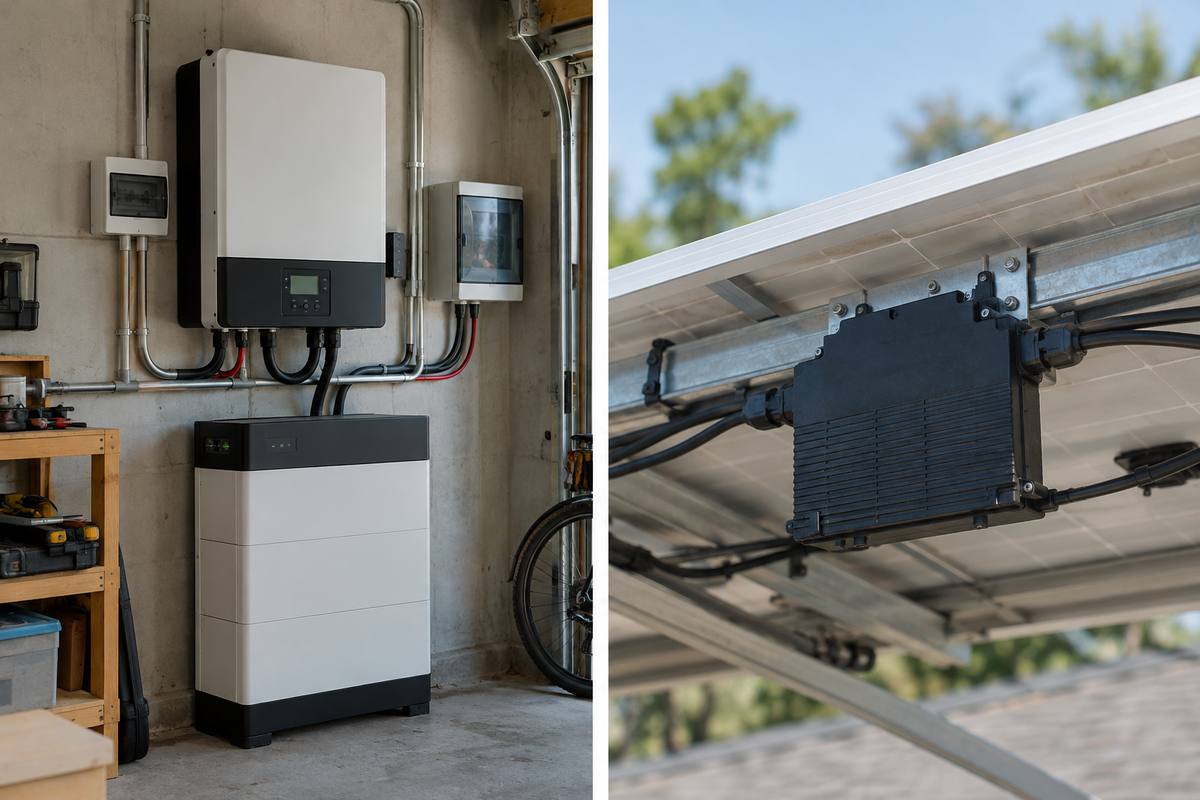
There are four main solar inverter types for homes: string inverters, string inverters paired with power optimisers, microinverters and hybrid inverters. All of them do the same core job, converting the direct current (DC) from your panels into the alternating current (AC) your home uses. Where they differ is in how they cope with shading, how much detail they report, what they cost and how easily they connect to a battery.
The right choice depends more on your roof than on any brand. A simple, unshaded south-facing roof rarely needs anything beyond a good string or hybrid inverter. A roof with chimneys, dormers and three orientations is a different story.
In short:
- String inverters are the simplest and cheapest option and work well on unshaded roofs with one or two orientations.
- Power optimisers and microinverters manage each panel individually, which helps with shading and gives panel-level monitoring.
- Hybrid inverters include a battery connection, making storage easier to add now or later.
- In the US, module-level rapid shutdown rules in many areas push installers towards microinverters or optimisers.
What an inverter does
Besides converting DC to AC, an inverter tracks the point at which your panels deliver the most power, a process called maximum power point tracking (MPPT). It also disconnects safely from the grid during a power cut and usually acts as the hub for your monitoring app.
Because it works hard every day, the inverter is the component most likely to be replaced during a system's life. Typical string inverters last around 10–15 years, while panels often last 25–30 years or more. Our guide to how long solar panels last covers component lifespans in more detail.
The four solar inverter types
String inverters
A string inverter is a single box, usually in the loft, garage or utility room. Panels are wired in series into one or more "strings", and the inverter manages each string as a unit.
Strengths: lowest cost, fewest components on the roof, easy access for repairs, mature technology.
Weaknesses: shading on one panel can drag down the output of the whole string, although bypass diodes inside the panels limit the damage. Monitoring is usually at system or string level only.
Multiple MPPT inputs. Many string inverters have two or more MPPT inputs. Each one can serve a separate roof face, so an east-plus-west layout works well without panel-level electronics, as long as there is little shading.
Power optimisers
Power optimisers are small DC units fitted behind each panel. Each one tracks its own panel's maximum power point and passes the result to a compatible string inverter.
Strengths: a shaded or dirty panel no longer pulls down its neighbours, monitoring shows every panel, and many designs offer panel-level shutdown.
Weaknesses: more electronics on the roof, higher cost, and you are usually tied to one manufacturer's inverter. A failed optimiser means a roof visit, although warranties are often long.
Some installers fit optimisers only on the shaded panels, which keeps costs down.
Microinverters
Microinverters convert DC to AC at each panel, so only AC cabling runs down from the roof. There is no central inverter at all.
Strengths: each panel works independently, the system expands easily one panel at a time, there is no high-voltage DC on the roof, and manufacturers often offer long warranties, in some cases up to 25 years.
Weaknesses: usually the most expensive option per watt, many units on the roof, and adding a battery needs a separate AC-coupled battery system with its own inverter.
Hybrid inverters
A hybrid inverter is a string inverter with a built-in battery connection. Solar power can charge the battery directly on the DC side, with fewer conversion steps than a separate battery inverter.
Strengths: the neatest route to battery storage, often only modestly dearer than a standard string inverter, and many models can provide backup power with additional equipment.
Weaknesses: it shares the string inverter's sensitivity to shading, and most hybrids only work with batteries on the manufacturer's approved list. Check compatibility before you choose a battery brand.
If you might add a battery within a few years, a hybrid inverter is often the sensible default. Our guide to solar battery storage in the UK explains AC and DC coupling, and the home battery comparison looks at specific systems.
String inverter vs microinverter vs optimisers: side by side
| String | String + optimisers | Microinverters | Hybrid | |
|---|---|---|---|---|
| Shading tolerance | Low to medium | High | High | Low to medium |
| Monitoring | System or string | Per panel | Per panel | System or string |
| Relative cost | Lowest | Medium to high | Highest | Low to medium |
| Battery readiness | Needs AC-coupled battery | Depends on inverter | Needs AC-coupled battery | Built in |
| Typical warranty | 5–12 years | Often 20–25 years on optimisers | Often 15–25 years | 5–12 years |
| Best for | Simple, unshaded roofs | Partial shade, complex roofs | Complex roofs, expansion | Battery now or later |
Warranty terms vary by manufacturer and region and can often be extended. Relative costs are indicative for a typical home system.
Which inverter type suits your roof
- Simple roof, no shade, no battery plans: a quality string inverter.
- Simple roof, battery now or later: a hybrid inverter.
- Two orientations, little shade: a string or hybrid inverter with two MPPT inputs.
- Chimney, tree or dormer shading part of the array: optimisers on affected panels, or microinverters.
- Several small roof faces: microinverters.
- US home where module-level rapid shutdown applies: microinverters, optimisers or another approved shutdown device, as your installer advises.
In Great Britain, installers often pair slightly more panel capacity with an inverter of about 3.68 kW to stay within the simpler grid-notification route. A little output is "clipped" on the sunniest days, which is normally a reasonable trade-off.
How to judge the best solar inverter for you
The best solar inverter is the one that fits your roof, battery plans and local support, not the one with the highest headline figure. Compare:
- Efficiency. Modern inverters typically convert around 96–98% of DC power. Small differences matter less than correct sizing.
- Warranty. Check the standard term, the cost of extending it and who handles claims locally.
- Grid compliance. In the UK, check the model is type-tested for G98/G99. In the US, look for the appropriate UL listing.
- Battery compatibility. For hybrids, confirm which batteries are supported.
- Monitoring. Try the app's demo if one exists. Good data makes faults easy to spot.
- Noise and location. Some units have cooling fans. A loft or garage is better than a bedroom wall.
Researching inverter makers and suppliers
Most homeowners buy an inverter as part of an installation, but it helps to know who makes it and who supports it locally. PVFirms lists 654 companies in its manufacturer category and 181 in distributors and components, as of October 2026. You can filter both by country, then check whether a brand has a local distributor before you commit. To find someone to fit it, use the solar installer directory. For how inverters fit with panel technology, read the solar panel technology guide.
Frequently asked questions
Are microinverters better than a string inverter?
Not automatically. On shaded or complex roofs, microinverters usually harvest more energy and give panel-level monitoring. On a simple, unshaded roof, a good string inverter performs similarly for less money, and it is easier to pair with a DC-coupled battery. Compare quotes for both on your specific roof.
Do I need power optimisers on every panel?
No. Optimisers help most on panels that are regularly shaded or face a different direction from the rest of the string. Some designs fit them only on affected panels. If none of your panels are shaded, the extra cost may not pay back, although panel-level monitoring has some value on its own.
Can I add a battery to an existing string inverter?
Yes, through an AC-coupled battery with its own inverter, which connects on the AC side of your system. Alternatively, when your existing inverter needs replacing, you can swap it for a hybrid model and connect a DC-coupled battery. A retrofit may also change your grid notification requirements.
How long do solar inverters last?
String and hybrid inverters typically last around 10–15 years, so many homes replace one inverter during the panels' lifetime. Microinverters and optimisers often carry longer warranties. Budget for at least one replacement in a long-term payback calculation.
Choosing your inverter: next steps
Ask each installer which inverter type they propose and why it suits your roof's shading and orientation. Then compare like for like using the manufacturer listings on PVFirms and shortlist installers who can explain their choice clearly.