Do Solar Panels Work in Winter? What to Expect from UK and Irish Systems Month by Month
By PVFirms Editorial Team, Published on 2026-10-24 • 7 min read
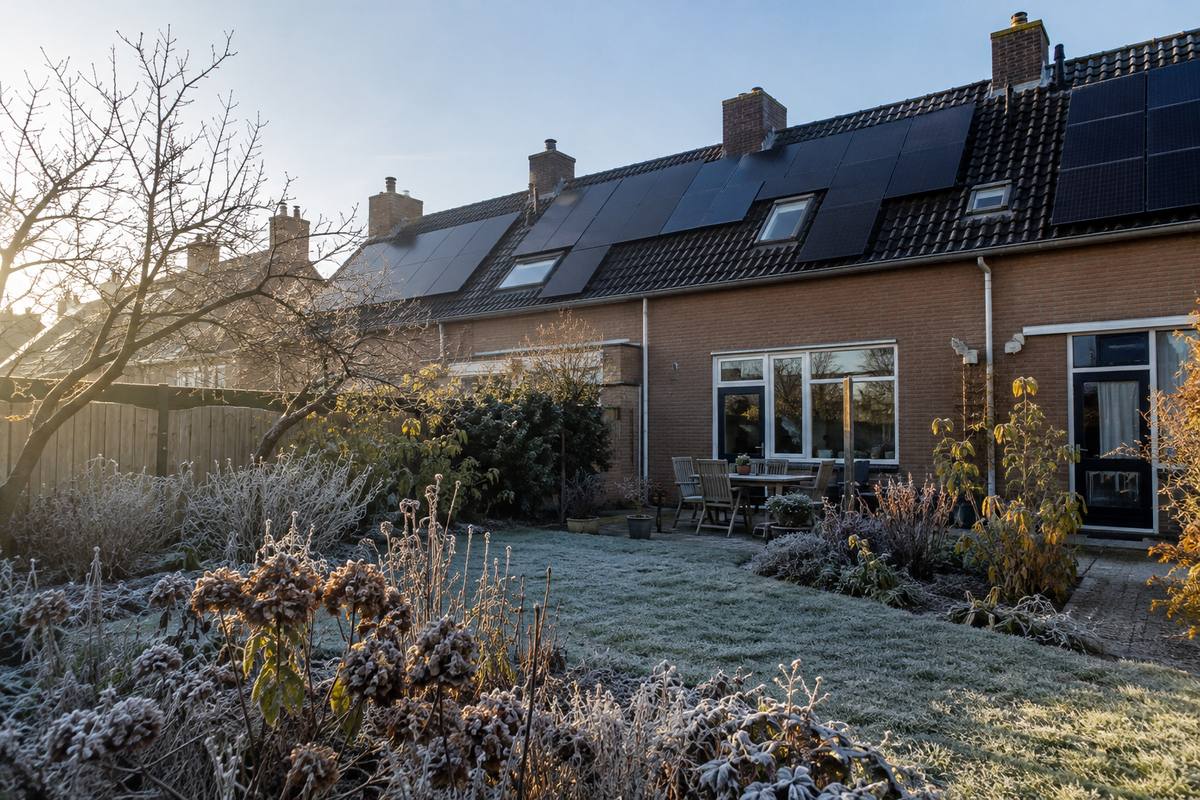
Yes, solar panels work in winter. They respond to daylight rather than warmth, so a cold, bright January morning can produce perfectly respectable power. What changes in winter is the quantity of light: days are short, the sun sits low and thick cloud is common across the UK and Ireland. Output falls sharply between November and February, but it rarely drops to zero.
The useful question is how much they produce, and whether that should change the system you buy. Below you will find a typical month-by-month output profile, what cloud, rain, snow and cold actually do to panels, and why sizing should follow annual output rather than December figures.
In short:
- Panels generate from diffuse daylight, so cloudy and rainy days still produce, just far less than sunny ones.
- In a typical UK or Irish system, November to February deliver only around a seventh of annual output (indicative).
- Cold weather slightly improves panel efficiency. Short days, a low sun and longer shadows are what cut winter yield.
- Size your system on annual generation and total usage, not on the darkest month.
How solar panels work on cloudy days
Solar cells convert light into electricity, and that light reaches your roof in two forms. Direct sunlight casts sharp shadows. Diffuse light has been scattered by cloud, haze and the atmosphere, and on an overcast day it is almost all you get.
Panels use both. Under bright, thin cloud a system still runs at a meaningful share of its rating, while heavy, dark cloud can cut output to a small fraction of full-sun levels.
That is why solar panels on cloudy days are still worth having in a maritime climate. A large share of the solar energy reaching the UK and Ireland each year arrives as diffuse light, and the yield estimates installers use already account for it. For more on how different cell designs handle varied light, see the solar panel technology guide.
Solar output by month in the UK: a typical profile
The table below shows how a south-facing 4 kWp system in southern England might spread its yearly output across the calendar. It assumes about 3,600 kWh a year, which is within the normal range for that location. Treat it as an indicative profile, not a forecast for your home.
| Month | Share of annual output | Approx. kWh | Approx. kWh per day |
|---|---|---|---|
| January | 3% | 110 | 3.5 |
| February | 5% | 180 | 6.4 |
| March | 8% | 290 | 9.3 |
| April | 11% | 395 | 13.2 |
| May | 13% | 470 | 15.2 |
| June | 13% | 470 | 15.7 |
| July | 13% | 470 | 15.2 |
| August | 12% | 430 | 13.9 |
| September | 9% | 325 | 10.8 |
| October | 7% | 250 | 8.1 |
| November | 4% | 145 | 4.8 |
| December | 2% | 70 | 2.3 |
June produces roughly six to seven times as much as December in this profile, while March and October still deliver useful amounts. Individual days vary far more than monthly totals suggest: a clear December day can beat a grey day in May.
Scotland, northern England and Ireland
Further north, the winter dip is deeper because the days are shorter and the sun lower still. Typical annual yields in Scotland and much of Ireland sit somewhere around 750–950 kWh per kWp, against roughly 900–1,050 in southern England. Summer carries an even larger share of the year, and December output in the far north can be very small.
What actually reduces winter output
Short days and a low sun
At the winter solstice, London gets just under eight hours of daylight and northern Scotland noticeably less. At midday the sun rises only about 15 degrees above the horizon in London, so its light passes through more atmosphere before reaching your roof.
Longer shadows
A chimney or a neighbour's tree that barely touches the array in June can shade several panels in December. Panel-level electronics can limit the losses; our comparison of solar inverter types explains when microinverters or optimisers are worth paying for.
Snow
Snow is the one winter condition that can stop generation completely, because a full covering blocks light. In most of the UK and Ireland it is infrequent and short-lived, and on smooth, tilted glass it tends to slide off once some light gets through. Never climb onto a frozen roof to clear it, and do not pour hot water on cold glass.
Rain
Solar panels in rain keep working, at reduced output because of the cloud. The water itself does no harm and on a tilted roof it rinses off dust and pollen. Our solar panel cleaning and maintenance guide covers the cases where rain is not enough.
Why cold weather helps rather than hurts
Panels are rated at a cell temperature of 25°C. Above that, output drops slightly; below it, output rises slightly. Manufacturers publish this as a temperature coefficient, typically around −0.3% to −0.4% per °C for modern modules.
On a hot July afternoon, cells on a dark roof can run well above 25°C and lose several percent of their rated power. On a crisp, clear February day they stay cool, so each unit of light is converted a little more efficiently. That is why monitoring apps sometimes show surprisingly strong peaks on cold, bright days in early spring.
Cold also raises panel voltage, so a competent designer checks that string voltage stays within the inverter's limits on the coldest mornings.
Size your system on annual output, not winter output
It is tempting to want a system that covers your bills in December. In practice that would mean an array far larger than most roofs can hold, with a huge summer surplus. A better approach:
- Start with annual usage. Take your yearly kWh from your bills.
- Use the sensible roof space. On a well-oriented roof, extra panels add relatively little cost per kWh, and export payments reward the summer surplus.
- Accept the seasonal gap. Winter output trims your bills while summer output does the heavy lifting.
- Treat a battery as a daily tool. A home battery moves daytime solar into the evening. It cannot bank July's sunshine for January.
For the panel maths, read how many solar panels you need. If you plan to run a heat pump, see our guide to solar panels and heat pumps, because heating demand peaks just as solar output bottoms out.
Finding an installer who designs for the whole year
A good installer models output for every month, accounts for winter shading and explains the seasonal profile before you sign. Ask for the estimated generation, a monthly breakdown and the shading assumptions in writing.
On PVFirms you can browse solar companies in the United Kingdom or solar companies in Ireland, filter by region and verification status, and request quotes free of charge without registering. Each profile shows its verification tier, so you can tell a firm whose registration and customer record have been checked from one that is simply listed. If a quote mentions unfamiliar terms such as kWp, MPPT or specific yield, the PVFirms solar glossary explains them.
Frequently asked questions
Do solar panels work on cloudy days in the UK?
Yes. Panels generate from diffuse daylight, so they keep producing under cloud. Output on a heavily overcast day is much lower than in full sun, sometimes only a small fraction, but bright, thin cloud can still deliver a useful amount. Cloudy weather is already built into the annual yield estimates that installers use for British and Irish homes.
Should I clear snow off my solar panels?
Usually not. Light snow tends to slide off tilted panels within a day or two once some light reaches the dark surface underneath. Climbing on a frozen roof is dangerous, and scrapers or hot water can damage the glass or frame. If the panels are within easy reach of the ground, a soft brush on a pole is acceptable.
How much do solar panels produce in December?
In the indicative profile above, a 4 kWp system in southern England generates about 2% of its yearly total in December, roughly 70 kWh. Northern locations produce less. Daily figures swing widely: a clear, cold day might give several kWh, while a dark, overcast day can deliver less than one.
Do I need a battery to use solar power in winter?
No. In winter almost all of your solar output is used in the home as it is generated, because it rarely exceeds daytime demand. A battery earns its keep mainly from spring to autumn, when there is real surplus to store. For costs and sizing, read our guide to solar battery storage in the UK.
Plan your system around the whole year
Check your annual electricity use, then ask installers for a month-by-month generation estimate rather than a single yearly figure. You can compare solar installers across the UK on PVFirms and request quotes for free.