Solar Battery Storage in the UK: What It Costs and When It Is Worth It
By PVFirms Editorial Team, Published on 2026-10-24 • 7 min read
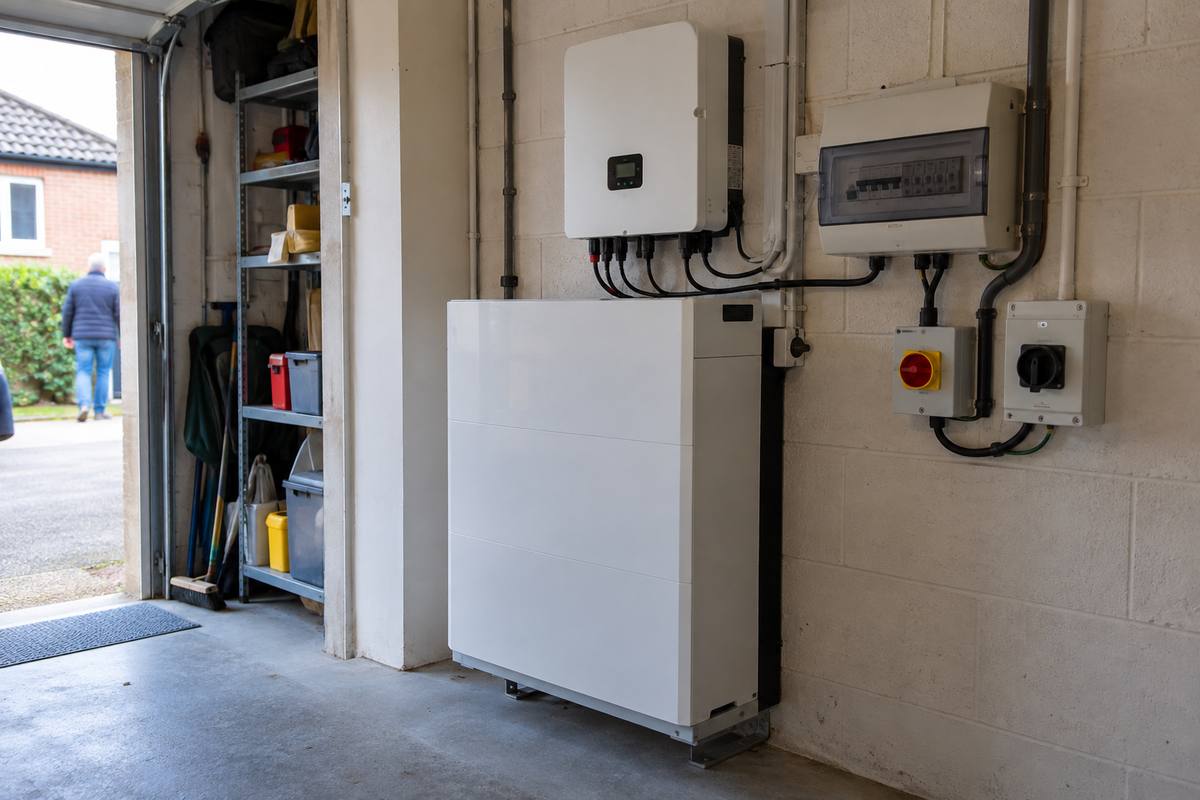
A battery does not make your panels generate more electricity. It moves the electricity you already generate from the middle of the day, when most homes are empty, to the evening, when the kettle, oven and television come on. Whether solar battery storage in the UK pays off depends on how big that evening gap is and what your tariffs pay or charge at different times.
Below we cover indicative 2026 prices, how to size a battery from your own usage, AC versus DC coupling, backup power, and a quick test for whether the investment suits your household.
In short:
- Indicative 2026 prices start around £2,500–£4,500 for a 5 kWh battery fitted alongside new panels.
- Size the battery on your typical evening and overnight use, not on your annual bill.
- DC-coupled batteries with a hybrid inverter suit new installs; AC-coupled units are the usual retrofit route.
- A battery works hardest when paired with a time-of-use tariff, but not every battery provides backup in a power cut.
How much does a solar battery cost in the UK?
Prices below are indicative ranges for 2026, including installation. "Usable capacity" is the energy you can actually draw, which is usually a little less than the nominal figure on the box.
| Usable capacity | Typical household fit | Fitted with new panels (indicative) | Retrofitted to existing panels (indicative) |
|---|---|---|---|
| 3–5 kWh | One or two people, modest evening use | £2,500 – £4,500 | £3,000 – £5,500 |
| 8–10 kWh | Family home with evening cooking and laundry | £4,500 – £7,500 | £5,000 – £8,500 |
| 13–16 kWh | High use, EV or heat pump, heavy tariff shifting | £7,000 – £10,500 | £7,500 – £11,500 |
Within each band, solar battery cost moves with brand, whether a new inverter is needed, backup hardware, cable runs and any electrical upgrades. Lithium iron phosphate is now the usual chemistry. In Great Britain, residential batteries are currently zero-rated for VAT, including batteries added to an existing system, with the relief scheduled to run until 31 March 2027. Check the latest position on GOV.UK before you budget.
Sizing: how many kWh do you actually need?
Look at how much electricity you use after the panels stop producing. Your smart meter data or supplier app usually shows half-hourly or hourly consumption.
Worked example (illustrative): a household uses 3,200 kWh a year, about 8.8 kWh a day. On a typical day, around 5 kWh of that is used between late afternoon and the next morning. A battery with 5–6 kWh of usable capacity would cover most of that evening load from spring to autumn.
Going much bigger rarely helps on solar alone. On many December days a typical 4 kW array produces only a few kWh, not enough to fill even a small battery. Larger batteries make sense mainly when you also charge from the grid on a cheap overnight rate, run an EV or a heat pump, or want longer backup.
AC-coupled or DC-coupled?
The two designs do the same job but connect differently.
- DC-coupled: the battery connects to a hybrid inverter on the panel side. Solar energy goes into the battery without an extra conversion, so efficiency is slightly higher. It is the neatest option for a new installation.
- AC-coupled: the battery has its own inverter and connects to your home's AC wiring. It works with almost any existing solar system, which makes it the standard choice for retrofits, at the cost of a little more conversion loss.
The solar inverter types guide covers hybrid inverters in more depth.
Retrofitting solar battery storage vs installing it with panels
Installing both at once saves a second visit, avoids duplicate electrical work and, with a hybrid inverter, keeps hardware costs down. If you are buying panels now but cannot stretch to a battery, ask for a hybrid inverter so the upgrade is simpler later.
Retrofits have one extra hurdle: grid notification. Adding a battery adds inverter capacity, and if the combined total exceeds the small-installation threshold, your installer must apply to the local network operator under the G99 process before connecting. That can add weeks. A good installer will flag this at quote stage and may propose export limiting to stay within limits.
How tariffs change the value of home battery storage
Tariff design now matters as much as battery size. Three generic patterns are worth understanding:
- Time-of-use import tariffs offer a cheaper window, usually overnight. Charging the battery then and using it at peak can save money even in winter, when solar output is low.
- Export tariffs that vary by time may pay more for electricity sent to the grid at peak times. A battery lets you hold solar energy back for those hours.
- Flat export tariffs reward self-consumption less, because exported and stored energy are valued similarly.
Some suppliers will not pay for exported electricity that was originally imported from the grid, so read the terms. The Smart Export Guarantee explainer shows how to compare export offers without being dazzled by a headline rate.
Will a battery keep the lights on in a power cut?
Not automatically. Grid-connected solar systems are designed to shut down when the grid fails, to protect engineers working on the lines. To keep power during an outage, you need a battery and inverter with a backup (often called EPS) function plus a switching device that isolates your home from the grid.
Backup usually covers selected essential circuits such as the fridge, lighting and broadband rather than the whole house. Changeover may take a few seconds. If backup matters to you, say so at the start, because adding it later can mean new hardware.
Are solar batteries worth it? A five-point test
A battery is more likely to pay its way if you can answer yes to most of these:
- You use a significant share of your electricity in the evening or overnight.
- You export a large amount of solar energy at present, or will after installing panels.
- You are willing to switch to a time-of-use tariff.
- You plan to stay in the home for at least the length of the battery warranty, typically around ten years.
- You value backup power, or plan to add an EV or heat pump.
If you already use most of your solar output during the day, the case is weaker. Our solar payback guide for UK homes sets out the full return calculation. For brand comparisons, our Tesla Powerwall vs BYD vs Huawei comparison looks at three popular systems.
Getting battery quotes from the right installer
Battery work involves inverter configuration, network notification and sometimes backup switching, so experience counts. The PVFirms guide on choosing a solar installer lists the checks worth making. You can browse solar companies in the United Kingdom or the wider installer directory, check each firm's verification tier and request quotes without charge. Ask each installer for the battery's usable capacity, warranty terms and expected annual savings, and the tariff assumptions behind them.
Frequently asked questions
What is the best solar battery for a UK home?
The best solar battery is the one sized to your evening usage, compatible with your inverter and backed by a solid warranty. Compare usable capacity, continuous power output, round-trip efficiency, warranty length and retained-capacity guarantee, and whether backup is supported. A well-known brand installed badly will underperform a mid-range unit installed and configured properly.
How long do home batteries last?
Most lithium iron phosphate home batteries carry warranties of around ten years, often guaranteeing that a minimum share of the original capacity remains at the end. Many will keep working beyond that with reduced capacity. Heat, very frequent full cycling and poor ventilation shorten life, so placement in a cool garage or utility room helps.
Can I add a battery without solar panels?
Yes. A standalone battery can charge from the grid during a cheap tariff window and power your home at peak times. The savings depend entirely on the price gap between your cheap and expensive rates. Without panels there is no free solar energy to store, so the case rests on tariff arbitrage alone.
Do I need planning permission for a home battery?
An indoor battery in a garage or utility room typically does not need planning permission, though building regulations and fire safety guidance on location still apply. Your installer should follow the manufacturer's clearances and keep the unit away from escape routes. Grid notification is a separate step and still applies if total inverter capacity rises.
Your next step with battery storage
Pull a month of hourly usage data from your smart meter app, note how much you use after dark, and use that figure to brief installers. Then compare like-for-like battery quotes from UK installers listed on PVFirms.