How to Compare Solar Quotes: A Line-by-Line Checklist and Template
By PVFirms Editorial Team, Published on 2026-10-24 • 6 min read
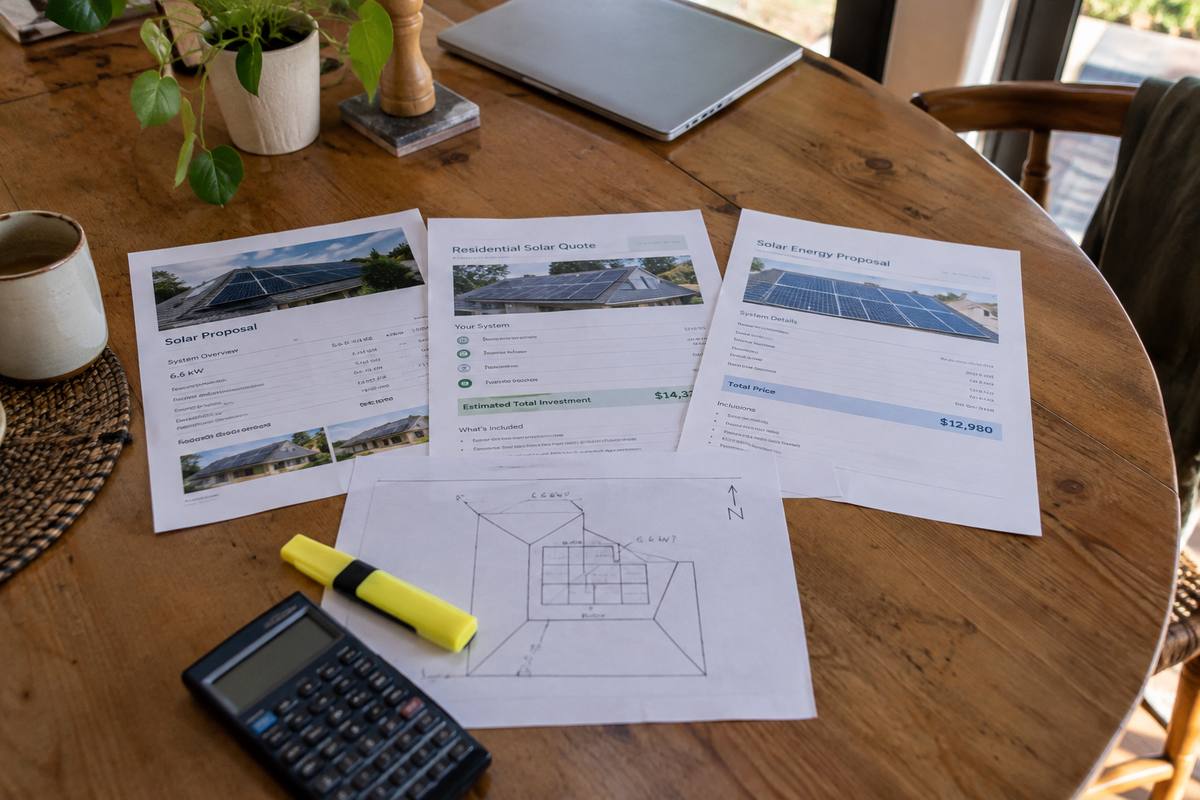
When three installers quote for "a 4 kW system", the totals can differ by thousands, and the cheapest is not always the best value. To compare solar quotes fairly, you need to look past the bottom line and check what each one actually includes: the exact hardware, the generation estimate behind it, the warranties and the payment terms.
This guide gives you a solar quote checklist to work through line by line, a template table you can copy, and a quick calculation that puts quotes of different sizes on equal footing. It applies whether you are in the UK, Ireland or the US. Only the certification names change.
In short:
- Ask every installer to quote on the same brief: your annual usage, roof photos and whether you want a battery.
- Check exact panel and inverter models, the yield estimate and its shading assumptions, and every warranty.
- Divide the price by expected first-year generation to compare quotes of different system sizes.
- Be cautious with large deposits; staged payments linked to milestones protect you.
Before you ask for solar panel quotes
Quotes are only comparable if installers start from the same information. Before the first survey, prepare:
- 12 months of electricity use, from your bills or supplier app.
- Photos of every roof face, including chimneys, vents, dormers and nearby trees.
- Your plans for the next five years: an EV, a heat pump, a loft conversion or moving house.
- A decision on batteries: none, now, or "battery-ready" with a hybrid inverter.
Send the same brief to each firm. If one installer proposes something different, such as a larger system or optimisers, ask them to quote your brief as well so you have a like-for-like baseline. Our guide to how many solar panels you need helps you set a sensible size.
The solar quote checklist, line by line
Panels
The quote should name the manufacturer, model and wattage, not just "430 W black panels". With the model number you can look up the datasheet, the temperature coefficient and the warranty terms.
Inverter
Again, look for an exact model. Check whether it is a string, hybrid or microinverter set-up, and whether optimisers are included. A hybrid inverter costs a little more but makes adding a battery later simpler. The solar inverter types guide explains when each option makes sense.
Yield estimate
A UK installer should provide a generation estimate calculated under the MCS method, with any shading factor stated. In the US, installers typically model output with dedicated design software. Ask what assumptions sit behind the number. An estimate noticeably higher than the others deserves a question, not automatic trust.
Mounting, scaffolding and access
Scaffolding, roof kit, bird protection and any electrical upgrades should be listed as included or excluded. A cheap headline price with scaffolding "to be confirmed" is not really cheap.
Monitoring
Find out whether monitoring is panel-level or system-level, whether it needs Wi-Fi, and whether there are ongoing app or data fees.
Warranties
List each warranty separately: panel product, panel performance, inverter, battery if included, and workmanship. Ask whether the workmanship warranty is insurance-backed.
Paperwork and payment schedule
The quote should state who handles grid notification, certification (MCS in the UK, SEAI grant paperwork in Ireland, permits and interconnection in the US) and when each payment is due.
A template to compare solar quotes side by side
Copy this table into a spreadsheet and fill one column per installer.
| Item | Quote A | Quote B | Quote C |
|---|---|---|---|
| System size (kWp) | |||
| Panel make, model, wattage | |||
| Inverter make and model | |||
| Optimisers or microinverters | |||
| Battery (usable kWh, model) | |||
| Estimated year-one generation (kWh) | |||
| Shading factor stated | |||
| Scaffolding and bird mesh included | |||
| Monitoring type and fees | |||
| Panel product / performance warranty | |||
| Inverter warranty | |||
| Workmanship warranty, insurance-backed | |||
| Certification and consumer code | |||
| Deposit and payment stages | |||
| Total price | |||
| Price per kWp | |||
| Price per year-one kWh |
Normalise the price before you compare
Different system sizes make totals misleading. Two simple ratios help:
- Price per kWp shows what you pay for capacity.
- Price per expected first-year kWh shows what you pay for output, which is what actually saves you money.
Illustrative example:
- Quote A: 4.3 kWp for £6,900, estimating 3,700 kWh. That is £1,605 per kWp and £1.86 per first-year kWh.
- Quote B: 4.0 kWp for £6,200, estimating 3,350 kWh. That is £1,550 per kWp and £1.85 per kWh.
- Quote C: 4.8 kWp for £7,800, estimating 4,250 kWh. That is £1,625 per kWp and £1.84 per kWh.
Quote C has the highest total but delivers the cheapest output, provided its yield estimate is realistic. It assumes about 885 kWh per kWp against roughly 840 for Quote B, so ask Installer C why. Different shading assumptions often explain the gap. The same maths works in euros or dollars.
Signs of a careful installer
Beyond price, these details separate thorough firms from rushed ones:
- They visited or surveyed the roof properly and noted its condition.
- The design shows panel layout on each roof face, not a generic count.
- They asked about your usage pattern before suggesting a battery.
- Their payment terms are staged, with the largest share due after commissioning.
- Their credentials check out: MCS certification plus RECC or HIES membership in the UK, SEAI registration in Ireland, and appropriate state licensing in the US, where NABCEP certification is a common mark of training.
Pressure to sign quickly, discounts that expire today or savings claims that look too good are reasons to slow down. Our article on spotting solar panel scams lists the common tactics.
Requesting free quotes through PVFirms
If you still need installers to quote, PVFirms lets you search the installer directory or the full solar company directory by country and region, then request quotes directly from company profiles at no cost. Each profile shows a verification tier. Verified and Premium Partner firms have had registration details and real customers checked by PVFirms, and the verification criteria are published. Questions worth raising on the first call are listed in choosing a solar installer: what to check.
Frequently asked questions
How many solar quotes should I get?
Three is the usual recommendation. Two may leave you without a tiebreaker, while more than four takes a lot of time for little extra insight. If two quotes are close and the third is an outlier, ask the outlier to explain the difference before dismissing or choosing it.
Is the cheapest solar quote a bad sign?
Not necessarily. A lower price may reflect lower overheads, a simpler roof or a different panel choice. It becomes a concern when the quote leaves out scaffolding or certification, names no hardware models, or comes from a firm without verifiable credentials. Check what is missing before assuming a bargain.
Should I pay a deposit for solar panels?
A modest deposit is normal, but large upfront payments carry risk if the company fails before installing. In the UK, consumer code members are generally required to protect deposits. Wherever you live, prefer staged payments, and paying part by credit card can offer extra protection under consumer credit rules.
Can I negotiate a solar quote?
Often, yes. Installers may adjust price if you are flexible on installation dates, accept a different panel brand of similar quality or share a competing quote. Negotiate on the full scope, not just the total, so you do not lose scaffolding, monitoring or warranty cover in exchange for a lower headline figure.
Ready to line up your quotes
Fill in the template for each quote, calculate price per kWp and per kWh, and ask every installer the same follow-up questions. If you need a third quote, find one in the PVFirms installer directory.